On this page
- Lagos in 2026: Still Worth the Hype?
- Getting Lost in the Old Town (Cidade Velha)
- Beaches: Choosing the Right One for Your Day
- Ponta da Piedade: The One Experience You Cannot Skip
- Water Sports and Ocean Activities
- Lagos for History Buffs
- Eating and Drinking in Lagos
- 2026 Budget Reality
- Day Trips from Lagos
- How to Get to Lagos and Get Around
- Frequently Asked Questions
💰 Click here to see Portugal Budget Breakdown
💰 Prices updated: August, 2026. Budget figures are estimates — always verify before travel.
Exchange Rate: $1 USD = €0.86
Daily Budget (per person)
Shoestring: €40.00 – €90.00 ($46.51 – $104.65)
Mid-range: €130.00 – €200.00 ($151.16 – $232.56)
Comfortable: €250.00 – €500.00 ($290.70 – $581.40)
Accommodation (per night)
Hostel/guesthouse: €15.00 – €45.00 ($17.44 – $52.33)
Mid-range hotel: €100.00 – €190.00 ($116.28 – $220.93)
Food (per meal)
Budget meal: €10.00 ($11.63)
Mid-range meal: €35.00 ($40.70)
Upscale meal: €100.00 ($116.28)
Transport
Single metro/bus trip: €2.00 ($2.33)
Monthly transport pass: €40.00 ($46.51)
Lagos in 2026: Still Worth the Hype?
Lagos has been on every “best of Algarve” list for years, and the crowds have followed. In 2026, the question most travellers are asking before they book isn’t whether Lagos is beautiful — they already know it is — it’s whether it’s still manageable. The short answer: yes, if you time it right and know where to go. This guide cuts through the Instagram version and tells you what the town actually offers, what it costs, and how to make the most of it without spending half your trip stuck in traffic or queuing for a boat trip.
Getting Lost in the Old Town (Cidade Velha)
The historic centre of Lagos sits inside what remains of its 16th-century defensive walls, and it’s compact enough to explore entirely on foot in a morning. Start at Praça Gil Eanes, the main square where the statue of King Sebastião stands surrounded by café terraces. From here, the streets fan out into a maze of whitewashed houses, iron balconies draped with bougainvillea, and narrow lanes that smell of sunscreen and strong coffee.
Walk south toward the waterfront along Rua Cândido dos Reis and Rua 25 de Abril — these are the main pedestrian arteries, lined with ceramic shops, independent restaurants, and the occasional hidden courtyard. The old town doesn’t demand a checklist. It rewards wandering. Duck down Rua Silva Lopes, check the tiles on the church doorways, and find a table before noon when the terraces fill up.
The medieval walls themselves are still largely intact along the waterfront. You can walk along sections of them and get an elevated view over the marina and out toward the Atlantic. The Arco de São Gonçalo, one of the original entry gates, is worth stopping to photograph in the early morning light when the golden stone glows before the day gets bright and flat.
Beaches: Choosing the Right One for Your Day
Lagos is surrounded by beaches, but they are not all the same. The right choice depends on what you want from your day.
Meia Praia
This is the longest beach near Lagos — stretching roughly 4 kilometres east of town. It’s wide, sandy, and family-friendly. The water is calmer here than on the more exposed Atlantic-facing beaches, and there’s decent infrastructure: beach bars, sun lounger hire, and easy parking. It’s the best choice if you want a long, uncomplicated beach day. Take the small ferry from the marina across the river mouth — it runs regularly in summer and costs around €1.50 each way.
Praia Dona Ana
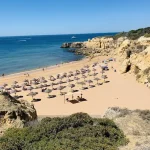
South of town, accessible by road or a 25-minute walk, Dona Ana is what most people picture when they imagine an Algarve beach: golden sandstone cliffs, turquoise water, and a cove shape that gives it some shelter. It’s popular and gets crowded by late morning in July and August. Arrive before 10:00 or accept that you’ll be sharing the sand closely with others.
Praia do Camilo
Smaller and more dramatic than Dona Ana, Camilo sits at the bottom of a steep wooden staircase cut into the cliffs. The rock formations here are some of the most photogenic near Lagos. Because of its size and the stairs, it’s less suitable for young children or anyone with limited mobility, but for everyone else it’s one of the most rewarding beaches in the area.
Porto de Mós

Further west and less visited, Porto de Mós is a broader beach with good surf conditions and a more local atmosphere. It’s a 30-minute walk from the centre or a short drive. If you want to escape the high-season crowds without leaving Lagos municipality, this is your best option.
Ponta da Piedade: The One Experience You Cannot Skip
About 2 kilometres south of Lagos town centre, the coastline fractures into a series of sea stacks, grottos, arches, and cathedral-like caves carved from honey-coloured limestone. This is Ponta da Piedade, and it is genuinely one of the most spectacular stretches of coastline in Western Europe.
You can see the cliffs from above by walking the signed trail from the car park to the lighthouse — the views across the Atlantic and back toward Lagos are extraordinary, especially in late afternoon when the light turns the rock almost orange. But the real experience is getting into the water level. Small wooden boats operated by local fishermen launch from the steps at the base of the cliffs and take groups through the caves and arches for around €15–20 per person for a 45-minute tour. These operators work independently, and in 2026 you still can’t pre-book them — you simply show up at the steps and negotiate. Morning or evening departures give you the best light and smaller groups.
Kayak and paddleboard hire is available from several operators along the beach at Dona Ana and Camilo, allowing you to paddle to Ponta da Piedade independently if conditions are calm. On still summer mornings, this is the most rewarding way to see the grottos — you can drift into the caves at your own pace, hear the water move inside the chambers, and watch the light filter green and gold through underwater openings beneath your board.

Water Sports and Ocean Activities
Lagos has built a solid reputation as one of the best bases for water sports in the Algarve, and the infrastructure in 2026 reflects that. The marina and surrounding beaches have multiple operators competing for business, which generally keeps prices reasonable and quality high.
- Surfing: Porto de Mós and Meia Praia both have surf conditions suitable for beginners. Several surf schools operate year-round, offering two-hour beginner lessons from around €35–45 per person including board and wetsuit. The best surf months are September through November when the swells are consistent and the beaches are far less crowded.
- Paddleboarding: Rentals are available at most beaches for €15–25 per hour. The calm inlets near Meia Praia are ideal for beginners.
- Dolphin watching: Several operators run two- to three-hour catamaran trips from the marina targeting common dolphins and bottlenose dolphins that live in the waters off the Algarve coast. Sightings are not guaranteed, but the success rate is high — most trips encounter dolphins. Expect to pay €40–55 per adult.
- Coasteering: A more physical option involving swimming, cliff jumping, and scrambling along the rock faces near the grottos. Organised groups of up to 10 people, supervised by guides, depart from near Dona Ana beach. Prices start at €50 per person.
- Scuba diving: The rocky reefs and underwater caves near Ponta da Piedade are home to octopus, moray eels, and occasional sunfish. Lagos has two established dive centres operating in 2026 with PADI-certified instructors.
Lagos for History Buffs
Lagos has a layered and sometimes uncomfortable history that goes well beyond its beaches. The town was an important hub during the Age of Discoveries and, more darkly, played a central role in the early Atlantic slave trade.
Mercado de Escravos (Slave Market Museum)
Located just off Praça da República, this is believed to be the site of the first public slave market in Europe, operating from the mid-15th century. The museum opened in its current form in 2016 and was updated with expanded exhibits in 2024. It handles a genuinely difficult subject with honesty and historical rigour, documenting the arrival of enslaved Africans brought by Portuguese expeditions. It’s not a comfortable visit, but it’s an important one. Entry costs €3.

Igreja de Santo António
Next door to the regional museum, this 18th-century church is one of the finest examples of Portuguese Baroque interior decoration in the Algarve. The walls and ceiling are covered floor-to-ceiling in gilded carved wood — a style called talha dourada — with a level of detail that makes the small space feel overwhelming in the best possible way. Entry is included with the regional museum ticket (€4 combined).
The Walls and Forte da Ponta da Bandeira
The 17th-century fort at the waterfront edge of the old town was built to protect the harbour entrance. It’s small but well-preserved, and the views from its ramparts over the mouth of the River Bensafrim are worth the €2 entry. Inside there’s a small exhibition on the Age of Discoveries.
Eating and Drinking in Lagos
The restaurant scene in Lagos has matured considerably over the past few years. You’ll still find tourist traps — avoid anything with a laminated picture menu on the main pedestrian streets — but the town has a strong core of genuinely good places.
For fresh fish and seafood, head to the covered market building (Mercado Municipal) on Rua das Portas de Portugal. The ground floor has stalls selling local produce, and the upper floor has a handful of simple lunch spots doing daily specials based on whatever came in that morning. A plate of grilled fish with potatoes and salad runs €9–13 and the quality is consistently good. The market is closed on Sundays.

Rua Silva Lopes and the streets around it have the highest concentration of independent restaurants with fixed menus and genuine kitchens. Look for places offering a menu do dia at lunch — typically €10–14 for a starter, main, drink, and dessert. Cataplana, the traditional copper-pot stew of clams, fish, or shellfish with tomato, onion, and coriander, is the dish Lagos does best. A proper cataplana for two will cost €30–50 depending on whether it’s based on clams or mixed shellfish.
For a drink after sunset, the streets around Rua Soeiro da Costa and Rua 25 de Abril come alive from about 19:00 onward. Many bars have street-facing windows or counters where you can stand with a cold Super Bock or a glass of local vinho verde and watch the town shift from afternoon to evening. In summer, the warm night air and the low murmur of a dozen languages mixing in the streets gives Lagos a quality that’s hard to find elsewhere in the Algarve.
2026 Budget Reality
Lagos is not a budget destination by Portuguese standards, but it’s still more affordable than equivalent coastal towns in Spain, Italy, or France. Here’s what to expect in 2026:
Accommodation
- Budget: Hostel dormitory bed €22–35 per night in high season. Several well-run hostels operate within walking distance of the old town.
- Mid-range: Guesthouse or small hotel double room €90–160 per night in July–August. Shoulder season (May–June, September–October) prices drop to €60–110.
- Comfortable: Boutique hotel or well-appointed apartment €170–280 per night in peak summer.
Food and Drink
- Budget: Market lunch or café sandwich €5–10. Supermarket self-catering is easy — there’s a Pingo Doce within 10 minutes of the centre.
- Mid-range: Sit-down restaurant dinner with wine €20–35 per person.
- Comfortable: Full seafood meal with a quality bottle of wine €50–70 per person.

Activities
- Ponta da Piedade boat tour: €15–20
- Surf lesson: €35–45
- Dolphin watching catamaran: €40–55
- Museum entries: €2–4 each
Overall, a realistic daily budget for one person including accommodation, meals, one activity, and local transport is €80–120 at mid-range. Budget travellers staying in hostels and cooking some meals can manage €45–60 per day.
Day Trips from Lagos
Lagos sits at the western end of the Algarve, which makes it an excellent base for day trips into the less-visited parts of the region.
Sagres (30 km west)
The village of Sagres sits on a dramatic promontory at the southwestern tip of continental Europe. Fortaleza de Sagres — the fortress — is worth an hour of your time, but the main draw is the landscape itself: vertiginous cliffs dropping into dark Atlantic water, wind-hammered scrubland, and a sense of genuine remoteness that’s rare in the Algarve. Praia do Beliche, just before the fortress, is one of the wildest and most beautiful beaches in Portugal. Drive takes 30–35 minutes. There’s also a bus connection from Lagos (Eva/Rede Expressos, around €3.50 one way), but service is limited — check current timetables before relying on it.
Silves (40 km east)
Silves was the Moorish capital of the Algarve for centuries and still has the most impressive castle in the region — a huge red sandstone alcáçova perched above the town. The surrounding orange groves and the slower pace of the town make for a strong contrast with coastal Lagos. Drive takes 40 minutes, or take the train from Lagos (CP regional service, around €3.70, 50 minutes with a change at Tunes in some services). The castle entry is €3.50.
Monchique (40 km north)
Up in the Algarve’s inland hills, Monchique is a world away from the coast. The town sits at around 450 metres elevation inside a protected mountain range covered in eucalyptus and medronho (arbutus) trees. The medronho firewater produced here is famous across Portugal — sharp, clear, and strong enough to make your eyes water. The drive up through the serra takes 45 minutes from Lagos and the temperature drop on a hot summer day is immediate and welcome. Several walking trails start from Fóia, the highest point in the Algarve at 902 metres.

How to Get to Lagos and Get Around
Getting There
The closest airport is Faro (FAO), approximately 90 kilometres east of Lagos. In 2026, Faro remains the main entry point for international visitors to the western Algarve, with direct connections from most major European cities including increased frequency from UK and German airports following new route additions in late 2025.
From Faro airport, the most practical option for most travellers is the direct bus operated by Eva Transportes to Lagos bus station, which takes approximately 1 hour 40 minutes and costs around €7–9. Alternatively, CP trains run from Faro to Lagos (requiring a change at Tunes), taking around 1 hour 50 minutes to 2 hours 15 minutes total and costing €8–12 depending on the service. A private transfer from Faro airport to Lagos costs €70–100 for a standard vehicle.
If you’re coming from Lisbon, the Rede Expressos coach from Sete Rios terminal covers the journey in around 4 hours and costs €19–26. The train (CP Alfa Pendular or Intercidades Lisbon Santa Apolónia to Lagos, with a change at Tunes) takes 3 hours 45 minutes to 4 hours 30 minutes and is similarly priced.
Getting Around Lagos
The old town is small enough to walk entirely. For beaches and Ponta da Piedade, options include:
- Car hire: Useful if you plan multiple day trips. Book in advance for peak summer — availability tightens quickly in July and August. Parking in the old town is limited; use the free car park near the stadium and walk in.
- Taxi and rideshare: Bolt operates in Lagos in 2026. Short rides to beaches cost €5–10.
- Bicycle hire: Several shops near the marina rent bikes by the day (€12–18). The flat terrain around Meia Praia is suitable for cycling; the road to Ponta da Piedade involves a significant climb.
- Ferry: The small passenger ferry to Meia Praia departs from the marina and runs frequently in summer (approximately every 20–30 minutes in peak season).

Frequently Asked Questions
When is the best time to visit Lagos?
May, June, and September are the ideal months — warm enough for swimming (sea temperatures reach 20–22°C), long daylight hours, and significantly fewer crowds than July and August. October remains mild and uncrowded. July and August are the hottest and busiest months; expect 35°C inland and packed beaches. Winter is quiet and cheap, but many restaurants and tour operators reduce hours or close.
Is Lagos safe for solo travellers?
Yes. Lagos is considered a very safe destination by European standards. Petty theft can occur in crowded areas during peak season — keep an eye on bags on busy beach days and in the main pedestrian streets. Solo female travellers consistently report feeling comfortable in Lagos both day and night. The town has a relaxed, social atmosphere and a large international visitor community year-round.
How many days do you need in Lagos?
Three full days gives you time to explore the old town, visit two or three beaches, do a boat trip or kayak tour to Ponta da Piedade, and enjoy the food and nightlife without rushing. Four to five days is better if you want to add day trips to Sagres and Silves. A single day is enough for a highlights visit if you’re passing through the Algarve.
Do I need a car to visit Lagos?

Not necessarily. Lagos town itself is very walkable, the ferry reaches Meia Praia, and taxis or Bolt can cover the beaches to the south. However, a car makes day trips to Sagres, Monchique, and Silves significantly more flexible and opens up more remote beaches. If you plan to stay mostly in Lagos, you can manage without one. If you want to explore the western Algarve broadly, hire a car.
Are the boat trips to Ponta da Piedade worth it?
Yes, for most visitors. The view from the clifftop is impressive, but entering the caves at water level is a genuinely different experience — the scale of the rock formations, the colour of the water inside the grottos, and the quiet when the engine cuts out make it memorable. The independent fishermen at the base of the steps offer roughly the same experience as the larger organised tours at a lower price. Kayaking to the grottos independently on a calm morning is the best version of all if you’re comfortable on the water.
Explore more
Algarve Nightlife Guide: Where to Find the Best Bars, Clubs & After-Dark Fun
The 7 Best Day Trips in Algarve for an Unforgettable Adventure
Your Ultimate Guide to Getting Around the Algarve: Transfers, Car Rental & Public Transport
📷 Featured image by Leonie Janko on Unsplash.