On this page
- How Safe Is Lisbon Really?
- The Neighbourhoods: Where to Stay Alert and Where to Relax
- Pickpocketing and Tourist Scams — The Exact Tactics Used
- Transport Safety in Lisbon
- Solo Female Traveller Safety
- LGBTQ+ Safety in Lisbon
- Emergency Numbers, Hospitals, and the Tourist Police
- Night Safety — Walking, Bars, and Getting Home
- Drug Laws and Public Behaviour
- 2026 Budget Reality — Safety-Related Costs
- Practical Safety Habits and Gear
- Frequently Asked Questions
💰 Click here to see Portugal Budget Breakdown
💰 Prices updated: August, 2026. Budget figures are estimates — always verify before travel.
Exchange Rate: $1 USD = €0.86
Daily Budget (per person)
Shoestring: €40.00 – €90.00 ($46.51 – $104.65)
Mid-range: €130.00 – €200.00 ($151.16 – $232.56)
Comfortable: €250.00 – €500.00 ($290.70 – $581.40)
Accommodation (per night)
Hostel/guesthouse: €15.00 – €45.00 ($17.44 – $52.33)
Mid-range hotel: €100.00 – €190.00 ($116.28 – $220.93)
Food (per meal)
Budget meal: €10.00 ($11.63)
Mid-range meal: €35.00 ($40.70)
Upscale meal: €100.00 ($116.28)
Transport
Single metro/bus trip: €2.00 ($2.33)
Monthly transport pass: €40.00 ($46.51)
How Safe Is Lisbon Really?
If you’ve been reading travel forums in 2026, you’ve probably seen two opposite takes on Lisbon: some people say it’s the safest capital in Europe, others come back frustrated after getting their phone snatched on Tram 28. Both experiences are real. The honest answer sits somewhere in the middle, and understanding exactly where that middle is will make your trip far more comfortable than any vague reassurance ever could.
Lisbon consistently ranks among the top ten safest cities in the Global Peace Index, and violent crime against tourists is genuinely rare. What is common — and has increased with the surge in tourism since 2022 — is opportunistic petty crime. Pickpocketing, bag snatching, and phone theft are the realistic risks you face, not mugging, assault, or anything more serious. Police presence in tourist zones increased again in 2025 following complaints from accommodation providers, and the PSP (Polícia de Segurança Pública) now has a dedicated tourist patrol unit operating year-round across Baixa, Alfama, and Belém.
Overall, Lisbon is a city where a sensible, aware traveller will almost certainly have zero incidents. The people who do get robbed are usually those who weren’t told what to watch for. This guide fixes that.
The Neighbourhoods: Where to Stay Alert and Where to Relax
Lisbon’s neighbourhoods have very different safety profiles, and the tourist-heavy areas are not always the safest ones.
Alfama
Alfama is beautiful and completely worth visiting, but it is the neighbourhood where tourists most frequently lose belongings. The steep, narrow lanes and crowded miradouros (viewpoints) are ideal conditions for pickpockets. This is especially true around Miradouro da Graça and the flea market at Feira da Ladra on Tuesday and Saturday mornings. Walk with your bag in front of you, keep your phone in a pocket rather than your hand, and be particularly alert in any crowd around Tram 28 stops.
Baixa and Rossio
The flat, central grid of Baixa is generally safe during the day, but Rossio square and Rua Augusta see a lot of street hustle — men offering roses or bracelets who become aggressive about payment, and occasional card game setups that are straightforward scams. The area empties late at night and walking through Baixa after midnight feels desolate rather than dangerous, but it’s better to take an Uber if you’re heading back alone.
Bairro Alto
At night, Bairro Alto’s tiny streets fill with hundreds of people drinking on the pavement outside bars. Pickpocketing happens in these dense crowds. It’s not a dangerous neighbourhood in terms of violence, but bag and phone theft in packed alleyways is well documented. Keep valuables minimal when you go out here.
Mouraria
Mouraria has gentrified significantly since 2020, and the streets around Intendente square are now busy with restaurants and bars. Parts of Mouraria further up the hill, away from the main square, can feel isolated late at night. Perfectly fine in daylight; use your judgment after dark.
Belém, Príncipe Real, and LX Factory Area
These are among the most relaxed areas for tourists. Belém is open and well-patrolled, Príncipe Real is an upscale residential neighbourhood with a calm atmosphere, and the area around LX Factory on weekends is busy and family-oriented. You’re unlikely to have any issues in any of these three zones.

Cais do Sodré and Santos
Cais do Sodré is Lisbon’s main nightlife strip along Rua Nova do Carvalho (Pink Street). It’s lively, crowded, and generally well-policed, but the combination of alcohol and tourist density means bag theft happens. Santos, just west, is quieter and has fewer incidents.
Intendente and Anjos
These working-class neighbourhoods north of Mouraria are increasingly popular with younger travellers. They’re fine during the day and in the early evening. After midnight, they’re less active and you should stick to well-lit streets or take a rideshare.
Pickpocketing and Tourist Scams — The Exact Tactics Used
Lisbon’s pickpockets are professional. Most operate in teams using distraction techniques that work even on experienced travellers. Knowing the specific plays they run is the single most effective protection.
The Tram 28 Press
This is the most reported theft scenario in Lisbon. Tram 28 runs through Alfama and gets extraordinarily crowded. As passengers press together near the doors, an accomplice creates a distraction — dropping something, asking a question — while a partner removes your phone or wallet. Solution: put your phone deep in a front trouser pocket or a zipped inner jacket pocket before boarding. Do not keep anything in a back pocket on any tram.
The Spray and Wipe
Someone sprays a liquid on you (ketchup, bird dropping, water) and immediately offers to help clean it up, distracting you while an accomplice goes through your bag. This is increasingly common near Praça do Comércio and Rossio. If someone suddenly tries to wipe something off your clothing, step back, hold your bag, and walk away.
The Friendship Bracelet
A man approaches, appears friendly, and starts weaving a bracelet onto your wrist before you’ve agreed to anything. Once it’s on, he demands payment. If you refuse or try to leave, he becomes aggressive. The best response is to refuse firmly before he touches your wrist — once the bracelet is started, the confrontation escalates. This happens near the Sé Cathedral and along Rua Augusta.
Fake Petitions
Someone approaches with a clipboard and asks you to sign a petition. While you’re focused on the paper, someone else is at your bag. Decline all clipboard-based interactions politely but immediately.
Card Game Setups
Three-card monte type games set up on cardboard boxes with apparent bystanders “winning.” The bystanders are part of the gang. You will not win. Do not engage.
Overcharging Taxis
Not violent, but still a scam worth knowing. Unlicensed taxis near the airport and cruise terminal quote flat rates that are three to four times the metered price. Always use the official taxi rank, request the meter, or use Uber or Bolt.
Transport Safety in Lisbon
Getting around Lisbon is safe, but specific transport scenarios carry higher risk than others.
Metro
Lisbon’s metro is clean, reliable, and generally safe. The Green and Yellow lines (serving Baixa-Chiado, Marquês de Pombal, and Rato) are the most tourist-relevant. In 2025, Carris Metropolitana expanded the network further into Loures and Odivelas, but tourists rarely venture to those ends of the lines where caution would be slightly more warranted at night. On crowded metro carriages — particularly at rush hour and around Christmas markets — apply the same awareness as on trams.
Tram 28
As noted, this is the highest-risk public transport route for theft. If you’re primarily riding it for the view (rather than actual transport), consider walking the Alfama route instead — you’ll see the same streets, have more freedom to stop, and face considerably less risk. Tram 15E to Belém is far less crowded and much lower risk.
Taxis and Rideshares
Licensed taxis (cream coloured with a blue stripe) are safe. Uber and Bolt both operate widely in Lisbon in 2026 and are generally the preferred option for tourists — pricing is transparent, the route is tracked, and you have a record of the driver. Avoid anyone touting for rides near the airport arrivals hall.
Airport Transfer
Humberto Delgado Airport (Lisbon’s only commercial airport) is 7 kilometres from the city centre. The metro Red Line connects the airport directly to Alameda and Oriente stations. It costs around €1.65 per journey plus a €0.50 card fee. This is perfectly safe and the easiest option for those arriving without heavy luggage. Officially metered taxis from the arrivals rank run approximately €15–€20 to Baixa. Anything quoted flat at €40+ near the arrivals doors is unofficial and overpriced.
Solo Female Traveller Safety
Lisbon is one of the better European capitals for solo female travellers, and that’s not just a diplomatic thing to say — it’s broadly supported by traveller reports. Serious assault is very rare. What solo women do encounter more frequently is verbal harassment, particularly in certain contexts.
Night-time harassment near the Pink Street bar strip and around Bairro Alto can involve persistent, unwanted attention. It rarely escalates beyond words, but it’s uncomfortable. Walking confidently and not engaging tends to be more effective than polite responses, which can be read as an invitation to continue the conversation.
For accommodation, solo female travellers consistently report positive experiences staying in Príncipe Real, Estrela, and the area around Avenida da Liberdade — quieter, well-lit neighbourhoods where returning late at night feels easy. Staying in Alfama requires more awareness, particularly on the steep lanes after midnight.
On public transport, sexual harassment is uncommon but not unheard of on late-night buses and the metro’s final runs. The front carriages are typically better lit and busier. Reporting apps and emergency buttons exist on the metro system and are functional.
Getting a local SIM card with data (see Practical Section below) means you always have Uber available, which significantly reduces the friction of getting home safely after a night out.
LGBTQ+ Safety in Lisbon
Portugal is one of the most LGBTQ+-friendly countries in Europe by both legal standard and social attitude. Same-sex marriage has been legal since 2010, adoption rights are equal, and anti-discrimination protections in employment and public life are strong. Lisbon hosted EuroPride in 2022 and the city’s annual Pride march in June 2025 drew over 70,000 participants — the largest in Portuguese history.
In practice, LGBTQ+ travellers report Lisbon as comfortable and generally welcoming. Public displays of affection between same-sex couples receive minimal attention in Príncipe Real, Bairro Alto, Cais do Sodré, and Intendente — the neighbourhoods with the highest concentration of LGBTQ+ social spaces. You may encounter more traditional attitudes from older residents in heavily residential areas away from the tourist core, but incidents of harassment are very rare.
Príncipe Real is often described as Lisbon’s unofficial LGBTQ+ neighbourhood, with a cluster of bars and restaurants around the garden on Rua da Escola Politécnica that are explicitly welcoming and well established. The area around Rua do Século and Rua Dom Pedro V has the highest concentration of LGBTQ+-owned businesses.
Emergency Numbers, Hospitals, and the Tourist Police
Knowing where to go before something goes wrong means you don’t have to figure it out while stressed.
Emergency Numbers
- 112 — Universal emergency number for police, ambulance, and fire (works from any phone, including with no SIM credit)
- 21 765 4242 — PSP Tourist Police (direct line, English-speaking staff)
- 808 24 7 24 7 — SNS24 (national health helpline, some English-speaking operators)
Hospitals
Hospital de Santa Maria (Avenida Professor Egas Moniz) is Lisbon’s largest public hospital and has an emergency department that sees foreign patients. Wait times are long — often three to five hours for non-life-threatening issues. For quicker treatment, private clinics are faster and still reasonably priced by Western European standards. CUF Descobertas in Parque das Nações and Hospital da Luz near Benfica are the two most commonly used by tourists with travel insurance. A GP-level consultation at a private clinic runs approximately €80–€120.
Tourist Police
The dedicated tourist police office at Palácio Foz (Praça dos Restauradores) is the right place to go if you’ve been pickpocketed or scammed. You need a police report (called a “participação”) for your travel insurance claim. Staff speak English, French, and Spanish. The process typically takes 30–45 minutes. You can also file online at the PSP website for minor thefts, though some insurers require an in-person report.
Night Safety — Walking, Bars, and Getting Home
Lisbon after midnight has a different energy depending on where you are. The main nightlife areas — Pink Street, Bairro Alto, Intendente — are busy until 3:00 or 4:00 in the morning on weekends and feel lively rather than threatening. The warm air in summer, the sound of bass from open bar doors, and groups of people spilling onto the streets create an atmosphere that feels social rather than edgy.
The areas to be more careful in after midnight are the streets between Alfama and Mouraria away from the main drag, the quieter parts of Santos, and isolated lanes anywhere away from active bar areas. These are not dangerous areas — this is not a city with violent no-go zones — but they’re dark, empty, and walking alone in them is unnecessarily exposed.
The practical rule most long-term Lisbon residents apply: if there are other people around, you can walk. If you’re on a dark, empty street and it’s past midnight, use Uber. It costs €4–€8 for most central journeys and removes any scenario where you might be followed without witnesses.
Drink spiking, while not a widespread problem, has been reported at a small number of nightclubs near Cais do Sodré. The standard advice applies: don’t leave drinks unattended, and accept drinks only from bartenders directly. Friends travelling together should watch out for each other in crowded club settings.
Drug Laws and Public Behaviour
Portugal famously decriminalised the personal possession of all drugs in 2001. This is frequently misunderstood by tourists, so here is the precise legal situation as it stands in 2026.
Decriminalisation does not mean legalisation. Possessing drugs for personal use (defined as up to a ten-day supply for personal consumption) is treated as an administrative offence rather than a criminal one. You will not be arrested and given a criminal record. You may receive a fine, a mandatory drug treatment consultation, or community service.
Selling or trafficking drugs remains a serious criminal offence with significant prison sentences. Possession of quantities above the personal threshold is prosecuted as supply.
In practice, tourists encounter street drug offers most frequently near Cais do Sodré, Intendente, and parts of Mouraria. Declining is straightforward and interactions very rarely become aggressive. Do not buy from street dealers — quality is unknown, the transaction is still technically an offence, and it often occurs in areas with police cameras.
Cannabis specifically: in 2023 Portugal began a regulated medical cannabis programme, but recreational sales in shops remain illegal. Tourists purchasing or smoking cannabis in public remain subject to the administrative offence process.
Public intoxication is a civil infraction. Being visibly and disruptively drunk in public can result in a fine (starting at €50) and temporary detention to sober up. Lisbon’s nightlife police are generally tolerant of people having a good time but respond firmly to aggressive or disruptive behaviour.
2026 Budget Reality — Safety-Related Costs
A few specific costs that relate directly to travel safety and peace of mind in Lisbon right now:
- Travel Insurance (EU residents): Short-trip policies covering theft and medical from €15–€35 for a week. Non-EU travellers should budget €30–€60 for comprehensive cover. Always check that your policy covers theft from a bag (not just bags left unattended — some policies specifically exclude this).
- NOS or MEO SIM card with 15GB data: €15–€20 from airport or central shops. Having data for Uber at all times is the single most cost-effective safety investment you can make.
- Uber from Pink Street to Príncipe Real at 2am: Approximately €5–€8. Worth every cent.
- Anti-theft bag (if buying locally): El Corte Inglés on Avenida Liberdade stocks basic anti-theft backpacks from €35–€65. Buying before you travel is cheaper.
- Private clinic consultation (if unwell): €80–€120 without insurance; reimbursable with most travel insurance policies.
- Police report for insurance (participação): Free. No charge to file at Tourist Police.
- Replacement SIM if phone stolen: €10–€15 for a new SIM with basic credit. Bring your cloud account passwords written somewhere offline — if your phone is gone, you’ll need them to access email for insurance contact.
Practical Safety Habits and Gear
No piece of equipment replaces awareness, but the right setup removes several risks entirely.
Bags
A cross-body bag worn in front of your body is the single most effective bag choice for Lisbon. Backpacks worn on the back are accessible to anyone standing behind you on a tram or in a crowd. If you carry a backpack, put it on your front in dense crowds. Bags with external zip pockets are easy targets. Bags with zips under a flap, or anti-cut straps, reduce risk significantly. You do not need an aggressively tactical anti-theft bag — a sensible cross-body bag worn correctly is sufficient for almost every tourist scenario.
Phones
Phone snatching from hands — someone grabbing your phone while you’re using it and running — happens in Lisbon. Keep your phone in a pocket when you’re not actively using it. If you need to use it for navigation, stop walking, stand with your back to a wall, check the route, put the phone away, and then walk. This single habit eliminates the most common phone theft scenario entirely.
Cards and Cash
Carry two cards stored separately — one for daily use, one kept in your accommodation as a backup. Contactless payment works at the vast majority of Lisbon establishments in 2026, so carrying large amounts of cash is unnecessary. Keep daily cash (€30–€50 is usually plenty) in a front pocket separate from your wallet. ATMs on Rua Augusta and around Rossio have functioning card skimmer covers and are generally safe; use bank-affiliated ATMs over standalone machines in tourist shops.
Digital Security
Before travelling, ensure your phone is set to require a PIN or biometric to unlock and has Find My Device (Android) or Find My iPhone (iOS) enabled. This lets you remotely wipe the phone if it’s stolen. Store your key documents (passport photo, insurance policy number, emergency contacts) in a cloud document accessible from any browser — not just the phone that might be stolen.
Travel Insurance
This is not optional. Portugal’s public health system is good, but waiting times at emergency departments are long. More importantly, if you’re robbed, insurance coverage means the financial impact is manageable. Make sure your policy covers the activities you’re doing — if you’re renting a scooter or doing water sports, confirm those are included. EHIC/GHIC cards (for UK and EU citizens) cover emergency public health treatment but not private care, repatriation, or theft.
Frequently Asked Questions
Is Lisbon safe to walk around at night?
Yes, in the main tourist and nightlife areas. Bairro Alto, Pink Street (Cais do Sodré), Príncipe Real, and Baixa are active and safe until late. Isolated streets in Alfama, Mouraria, or away from active bar zones after midnight are better navigated by Uber. Violent crime against tourists walking at night is very rare.
What is the biggest safety risk for tourists in Lisbon?
Pickpocketing and phone snatching, overwhelmingly. Tram 28, crowded miradouros in Alfama, and packed nightlife streets are the most common locations. Violent crime, scams involving physical threat, and robbery at knifepoint are not the realistic risks — opportunistic theft by skilled pickpockets is. A cross-body bag worn in front and phone kept in a pocket eliminate most exposure.
Is Lisbon safe for solo female travellers?
Generally yes. Violent assault is very rare. Solo women do experience verbal harassment, most commonly near Bairro Alto and Cais do Sodré at night. It very rarely escalates beyond words. Staying in Príncipe Real or Estrela, using Uber to get home late, and having a local SIM for data access makes solo travel in Lisbon comfortable and practical.
Which areas of Lisbon should tourists avoid?
There are no genuine no-go zones in Lisbon. The areas requiring more awareness are steep Alfama lanes at night, quiet parts of Mouraria after midnight, and isolated streets in any neighbourhood away from active foot traffic. Staying on well-lit, populated streets and using rideshares for late-night returns covers you in any neighbourhood.
What should I do if I am pickpocketed in Lisbon?
Go to the Tourist Police office at Palácio Foz (Praça dos Restauradores), open daily from 8:00 to midnight. Report the theft and request a participação (police report) for your insurance claim. Contact your bank immediately to freeze any stolen cards — most banks have 24-hour international lines and support card freezing via app. Report the theft to your travel insurer within 24 hours.
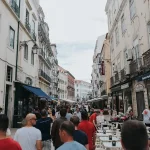
📷 Featured image by Denise Jans on Unsplash.