On this page
- What Makes Setúbal Different From Other Portuguese Coastal Towns
- The Arrábida Natural Park: Where the Atlantic Meets the Mountains
- Dolphin Watching and the Sado Estuary: A Wild Encounter Close to Lisbon
- Where to Eat in Setúbal: Seafood Seriously Done Right
- Getting to Setúbal from Lisbon and Porto
- Getting Around Setúbal and the Arrábida Coast
- Day Trip or Overnight? How to Decide
- 2026 Budget Reality: What Things Cost in Setúbal
- Frequently Asked Questions
💰 Click here to see Portugal Budget Breakdown
💰 Prices updated: August, 2026. Budget figures are estimates — always verify before travel.
Exchange Rate: $1 USD = €0.86
Daily Budget (per person)
Shoestring: €40.00 – €90.00 ($46.51 – $104.65)
Mid-range: €130.00 – €200.00 ($151.16 – $232.56)
Comfortable: €250.00 – €500.00 ($290.70 – $581.40)
Accommodation (per night)
Hostel/guesthouse: €15.00 – €45.00 ($17.44 – $52.33)
Mid-range hotel: €100.00 – €190.00 ($116.28 – $220.93)
Food (per meal)
Budget meal: €10.00 ($11.63)
Mid-range meal: €35.00 ($40.70)
Upscale meal: €100.00 ($116.28)
Transport
Single metro/bus trip: €2.00 ($2.33)
Monthly transport pass: €40.00 ($46.51)
Most visitors driving south from Lisbon toward the Algarve pass within 40 kilometres of Setúbal without stopping. That’s their loss. In 2026, with the Algarve coast increasingly overcrowded from June through September and Sesimbra booked solid most weekends, Setúbal has quietly become one of the best-value, least-packaged destinations in western Portugal. It has a working fishing port, one of Europe’s most dramatic natural parks on its doorstep, and a resident dolphin population in the Sado Estuary. The challenge isn’t finding things to do — it’s deciding what to skip.
What Makes Setúbal Different From Other Portuguese Coastal Towns
Setúbal (pronounced roughly “se-TOO-bal”) is a genuine Portuguese city of around 120,000 people. It isn’t a resort town that closes in November. The fish market opens early on weekday mornings. Local families eat lunch in the restaurants along the waterfront. The historic centre, while not as polished as Évora or Óbidos, has real texture — narrow streets around the Igreja de Jesus, the oldest Manueline church in Portugal, built in the 1490s.
What separates Setúbal from similar-sized Portuguese cities is its position. To the south, the Serra da Arrábida ridge drops dramatically into the Atlantic, creating some of the clearest, most turquoise water in mainland Europe. To the east, the Sado Estuary is a protected wetland where bottlenose dolphins have lived year-round for decades. This isn’t a coincidence of geography — it’s the reason to come here rather than anywhere else.
The city itself is largely unpretentious. Azulejo-tiled buildings line the main pedestrian streets. There’s a covered market, a handful of decent museums, and a fortress (Forte de São Filipe) with views over the estuary that justify the short climb. But Setúbal works best as a base, not as a destination that demands your full attention indoors.
The Arrábida Natural Park: Where the Atlantic Meets the Mountains

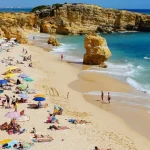
The Parque Natural da Arrábida runs for roughly 30 kilometres along the coast southwest of Setúbal, and it is genuinely one of the most beautiful stretches of coastline in Europe. The limestone Serra da Arrábida ridge rises to around 500 metres and drops almost vertically into the sea. The water below — protected from development and from most tourist infrastructure — is the kind of blue-green you’d expect in Greece or Croatia, not 40 kilometres south of Lisbon.
The main beaches inside the park — Portinho da Arrábida, Galapinhos, Galapos, and Figuerinha — are accessible by road, though Portinho and Galapinhos require either a shuttle bus or a park-regulated vehicle permit between June and September. Since 2023, the Arrábida park authority has capped daily vehicle numbers at these beaches to protect water quality and vegetation. In 2026 that system remains in place, and booking your shuttle or permit slot ahead of time is essential on summer weekends.
Standing at Portinho da Arrábida on a calm morning, with the white limestone cliffs behind you and water so clear you can see every rock on the seabed 4 metres down, the silence is striking — no jet skis, no beach bars pumping music, just the sound of the Atlantic against stone. The park rules that frustrate some visitors are exactly what preserves that experience.
Beyond the beaches, the park has well-marked walking trails. The Trilho dos Arcos connects several of the main viewpoints and takes around 3.5 hours at a relaxed pace. The monastery of Nossa Senhora da Arrábida, built into the cliff face in the 16th century, is visible from the road and accessible on foot — one of the more surreal architectural sights in the region.

Dolphin Watching and the Sado Estuary: A Wild Encounter Close to Lisbon
The Sado Estuary east of Setúbal is home to a resident community of around 30 bottlenose dolphins — one of only a handful of fully sedentary dolphin populations in Portugal. Unlike offshore dolphin tours that operate on luck and open-water conditions, the Sado dolphins are genuinely resident. They feed in the estuary, socialise in its channels, and have been studied continuously since the 1980s. The probability of seeing them on a morning boat trip is consistently high, typically above 90% during the calmer months.
Several licensed operators run 2.5 to 3-hour tours from Setúbal’s waterfront. Trips depart in the morning, which offers the best light and typically calmer water. The estuary itself is worth the journey regardless of dolphin sightings — it’s a UNESCO-recognised biosphere reserve, and the birdlife along the margins (flamingos, spoonbills, herons in the shallower sections) is exceptional from autumn through spring.
Prices for dolphin watching tours in 2026 sit between €35 and €55 per adult depending on the operator and boat size. Smaller rigid inflatable boats (RIBs) get closer to the dolphins and move faster; larger catamarans are more stable for people who feel uneasy on the water. Children under 6 are typically free. Book directly with operators rather than through aggregator sites — you’ll usually pay less and can ask specific questions about what to expect.
The best months for calm estuary conditions are May through October. November through February can be beautiful and uncrowded, but wind and rain are more likely, and some operators reduce their schedule. March and April are underrated — the estuary is quiet, the dolphins are active, and accommodation prices are noticeably lower.

Where to Eat in Setúbal: Seafood Seriously Done Right
Setúbal has a legitimate claim to being one of the best places in Portugal to eat grilled fish. The city sits at the junction of the Atlantic coast and the Sado Estuary, which means the catch is genuinely local and genuinely fresh. The fish market (Mercado do Livramento, a short walk from the waterfront) is worth visiting before 9am if you want to understand what’s in season — the stalls are loud, fast-moving, and the ice-covered displays change daily.
Choco frito — battered and deep-fried cuttlefish — is the defining dish of Setúbal’s food culture. It’s on nearly every menu in the city, but the quality varies enormously. The best versions have a thin, crispy shell that gives way to tender cuttlefish, not the dense, rubbery interior you get at places that freeze their stock. The smell of choco frito drifting from a kitchen window is a reliable signal that a restaurant knows what it’s doing.
For specific restaurants: Mané near the covered market is a no-frills lunch spot that locals have been eating at for decades — expect grilled fish, paper tablecloths, and no English menu. Restaurante O Cravo on Rua António Maria Baptista does excellent linguado (sole) and has a wine list that takes the region’s Setúbal Moscatel seriously. For something more relaxed along the waterfront, the restaurants around Avenida Luísa Todi are a reasonable option for an evening meal, though a few have become more tourist-oriented in recent years — check for a handwritten specials board as a sign of freshness.

Setúbal is also the home of Moscatel de Setúbal, a fortified wine made from Muscat grapes grown on the slopes above the estuary. It ranges from golden and floral to deep amber and intensely sweet depending on ageing. Any decent restaurant will have several versions by the glass. Try it with local sheep’s cheese or simply on its own after a long lunch — it’s one of Portugal’s most underappreciated wine styles.
Getting to Setúbal from Lisbon and Porto
From Lisbon, Setúbal is one of the easiest regional day trips to organise without a car. The CP (Comboios de Portugal) Fertagus line runs from Lisbon’s Roma-Areeiro or Entrecampos stations across the Tagus bridge and connects at Setúbal station. Journey time is around 50–60 minutes depending on the service. In 2026, Fertagus runs frequent departures throughout the day — typically every 20–30 minutes during peak hours — and the standard single ticket costs around €3.60 with a Navegante card or approximately €4.50 without one. The train station in Setúbal is a short walk from the city centre and waterfront.
Alternatively, Rede Expressos and TST buses run from Lisbon’s Praça de Espanha and Oriente terminals to Setúbal in roughly 50–70 minutes. Buses drop passengers more centrally than the train station in some cases. Check current schedules on the Rede Expressos website, as timetables shift seasonally.
From Porto, the direct journey by train requires a change in Lisbon and takes between 3.5 and 4.5 hours total depending on connections. For a day trip from Porto, Setúbal is too far — it works better as a stop during a Lisbon-based trip or as part of a longer Alentejo or Peninsula de Setúbal itinerary. If you’re driving from Porto, the A1 to Lisbon and then the A2 south puts you in Setúbal in around 3.5 hours.

By car from Lisbon, the drive via the A2 takes around 40–45 minutes without traffic. Having a car gives you access to the Arrábida beaches and the Sado Estuary viewing points that public transport doesn’t reach efficiently — it’s the single biggest advantage for visitors planning more than one day in the area.
Getting Around Setúbal and the Arrábida Coast
The city centre of Setúbal is compact and walkable. The waterfront, the historic centre around Igreja de Jesus, the covered market, and the Forte de São Filipe can all be reached on foot from any central accommodation. Local buses (TST) connect the city to some suburban areas, but for the Arrábida coast and the estuary, your options in 2026 are essentially: rent a car, join an organised tour, or use the seasonal shuttle buses.
Car rental is available at Setúbal train station and from agencies in the city centre. Rates in 2026 for a small car start around €35–45 per day including basic insurance. Renting for even a single day unlocks the Arrábida viewpoints, the quieter inland villages like Vila Nogueira de Azeitão (known for its wine estates and Moscatel production), and the eastern estuary roads where flamingos feed in the shallower channels.
Cycling is possible along the waterfront and on some of the flatter estuary roads east of the city, but the Arrábida ridge is serious climbing — not recommended unless you’re an experienced cyclist with a suitable bike. Several local operators offer guided cycling tours on the easier coastal paths.
Taxis and rideshare (Bolt operates in Setúbal in 2026) are practical for short trips within the city. For getting to Portinho da Arrábida or Galapinhos beach without a car in summer, the park shuttle is the most reliable option — it runs from a designated stop near the waterfront and handles the parking restrictions that apply inside the park.

Day Trip or Overnight? How to Decide
A day trip from Lisbon to Setúbal is absolutely workable if your main goal is a specific activity — dolphin watching in the morning, lunch in the city, then the train back. You can do it comfortably without feeling rushed. The train connection is smooth, and the waterfront area where most activities are based is a five-minute walk from the station.
But staying overnight changes what’s possible significantly. Arrábida beach access is far easier in the early morning before the shuttle system reaches capacity. The estuary light at dawn — when the water is glassy and the dolphins are most active — is difficult to access on a day-trip schedule from Lisbon. Evening in the city is genuinely pleasant: the restaurants along Avenida Luísa Todi are quieter after the day-trippers leave, and the Forte de São Filipe at sunset, looking west over the estuary as the sky turns deep orange over the water, is one of those views that tends to anchor itself in memory.
Two nights is the sweet spot for most visitors. Day one: Arrábida coast and beaches. Day two: dolphin watching in the morning, city exploration in the afternoon, Moscatel tasting in the evening. If you’re combining Setúbal with a trip to the Alentejo or the Serra de São Mamede, it works well as a first or last stop — the A2 south from Setúbal puts you into the Alentejo within an hour.
Hotels and guesthouses in the city centre are reasonably priced by Portuguese standards. For Arrábida itself, options are limited — a few rural tourism properties and one or two small hotels near Portinho. If you want to be close to the beaches, book those early; they’re small operations and fill quickly in July and August.

2026 Budget Reality: What Things Cost in Setúbal
Setúbal remains genuinely affordable compared to Lisbon, the Algarve, or Sintra. Here’s what to expect across different budget levels in 2026:
Accommodation (per night, double room)
- Budget: €45–70 — Basic guesthouses and smaller pensões in the city centre. Clean, functional, some without air conditioning.
- Mid-range: €80–130 — Three-star hotels near the waterfront or in the historic centre. Most include breakfast.
- Comfortable: €150–220 — Boutique properties or rural tourism estates near Arrábida. These include places with pools and direct access to the natural park.
Food and Drink
- Budget: €10–14 per person — A lunchtime menu do dia (soup, main, drink, dessert or coffee) at a local tasca.
- Mid-range: €20–35 per person — Sit-down dinner at a proper seafood restaurant with wine, including choco frito and grilled fish.
- Comfortable: €45–65 per person — Upscale seafood or a wine-focused meal with regional Moscatel pairings.
Activities
- Dolphin watching tour: €35–55 per adult
- Arrábida park shuttle (return): approximately €5–8 per person
- Guided kayak tour in Arrábida: €45–65 per person
- Car rental (daily): €35–45 for a small car
- Forte de São Filipe entry: free or nominal fee (check current status on arrival)
Overall, a two-day visit to Setúbal including accommodation, meals, and one dolphin tour or Arrábida activity can be done comfortably for around €200–280 per person at mid-range level. That’s significantly less than comparable itineraries in the Algarve or Cascais.
Frequently Asked Questions
Is Setúbal worth visiting as a day trip from Lisbon?
Yes, easily. The train from central Lisbon takes under an hour and runs frequently. A day trip works well for dolphin watching or a focused city lunch. However, if you want proper beach time at Arrábida or early morning estuary access, one or two nights on the ground makes a noticeable difference to what you can fit in.

When is the best time to visit Setúbal?
May, June, and September offer the best combination of good weather, manageable crowds, and full activity schedules. July and August are peak season — beaches are busy and the Arrábida shuttle can fill up. March and April are underrated for dolphin watching and walking, with lower prices across the board.
Are the Arrábida beaches suitable for children?
Generally yes. The water is calm, clear, and relatively shallow at Portinho da Arrábida and Figuerinha. There are no strong currents in most conditions. Some beaches require a short walk from the shuttle drop-off point. There are limited facilities at the most protected beaches — bring your own food, water, and sun protection.
Do I need to speak Portuguese in Setúbal?
Basic English is spoken at hotels, tour operators, and most restaurants in the centre. Smaller tascas and the fish market operate primarily in Portuguese. Learning a few phrases — choco frito, uma mesa para dois, a conta por favor — goes a long way and is genuinely appreciated by locals who aren’t accustomed to heavy tourist traffic.
Can I visit Arrábida without a car in 2026?
Yes, during the summer months the park shuttle runs from Setúbal to the main beaches. Outside the shuttle season (roughly October through April), access without a car is difficult. Tour operators in Setúbal also run guided half-day trips to Arrábida by minibus, which is a practical alternative if you’re not renting independently.
📷 Featured image by Carlos Machado on Unsplash.