On this page
- The Convento de Cristo — The Templar Fortress That Started It All
- Beyond the Convent: Tomar’s Old Town and the Medieval Street Grid
- The Manueline Window — Portugal’s Most Dramatic Piece of Stone Carving
- Tomar’s Food Scene — Where Locals Actually Eat
- Day Trip or Overnight? — Honest Advice on Timing Your Visit
- Getting to Tomar by Train and Bus in 2026
- 2026 Budget Reality — What Everything Costs Now
- Frequently Asked Questions
💰 Click here to see Portugal Budget Breakdown
💰 Prices updated: September, 2026. Budget figures are estimates — always verify before travel.
Exchange Rate: $1 USD = €0.88
Daily Budget (per person)
Shoestring: €40.00 – €70.00 ($45.45 – $79.55)
Mid-range: €150.00 – €300.00 ($170.45 – $340.91)
Comfortable: €400.00 – €1,000.00 ($454.55 – $1,136.36)
Accommodation (per night)
Hostel/guesthouse: €15.00 – €50.00 ($17.05 – $56.82)
Mid-range hotel: €70.00 – €150.00 ($79.55 – $170.45)
Food (per meal)
Budget meal: €10.00 ($11.36)
Mid-range meal: €25.00 ($28.41)
Upscale meal: €60.00 ($68.18)
Transport
Single metro/bus trip: €1.90 ($2.16)
Monthly transport pass: €40.00 ($45.45)
Tomar has a problem with daytrippers — not too few of them, but too many who leave after two hours having only seen the convent from the outside. In 2026, the Convento de Cristo draws serious visitor numbers, yet the town below remains genuinely uncrowded and almost entirely free of the souvenir-shop saturation you find in Sintra or Óbidos. If you plan your visit poorly, you’ll rush the one site that genuinely needs time and miss the town that gives it meaning. This guide is built to stop that from happening.
The Convento de Cristo — The Templar Fortress That Started It All
The Knights Templar arrived in Tomar in 1160, when Gualdim Pais, the order’s Portuguese master, chose this hilltop above the River Nabão to build their headquarters. What makes the site extraordinary is that it never stopped being built. Over four centuries, successive military orders and Portuguese kings layered Gothic cloisters onto Romanesque foundations, wrapped Manueline decoration around Gothic stone, and added Renaissance courtyards to the outside of all of it. The result is not a single building but a palimpsest — each era visible if you know where to look.
The heart of everything is the Charola, the original Templar rotunda built in the 12th century. It is modelled loosely on the Church of the Holy Sepulchre in Jerusalem, which tells you exactly what the Templars considered their spiritual reference point. The interior is sixteen-sided, dark, and faintly overwhelming — gilded panels, painted figures, and a central altar that knights were said to ride around on horseback during Mass. Whether that story is entirely true barely matters. Standing inside the Charola, you feel the specific weight of an institution that believed itself to be fighting for the literal salvation of the world.
Allow at least two hours for the full site. The audio guide (included with most tickets) is genuinely useful here — the architectural layers are confusing without context. Wear comfortable shoes; the upper terraces involve uneven stone and some steep stairs.
Beyond the Convent: Tomar’s Old Town and the Medieval Street Grid
Most visitors take the shuttle or walk the hill path back down to the car park and leave. That is a mistake. Tomar’s old town is one of the best-preserved medieval urban layouts in Portugal, and it is almost entirely free of crowds even on a busy August weekend.

The town was laid out by the Templars in the 12th century on a strict grid plan — unusual for medieval Portugal, which generally let its towns grow organically along river banks and trade routes. The straight streets, the central Praça da República, and the relationship between town and hilltop fortress were all deliberate. You are walking through a planned garrison city, not a market town that grew over time.
Praça da República itself is anchored by the Igreja de São João Baptista, a late Gothic church with a Manueline portal that would be famous in almost any other Portuguese town. Here, because it sits in the shadow of the convent, it is often ignored. The bell tower is original 15th century. The painted panels inside are attributed to the workshop of Jorge Afonso and are among the finest in the region.
The Rua Serpa Pinto corridor running south from the square still has the scale and proportions of a medieval street — narrow, shaded by old stone buildings, with the occasional wooden balcony overhead. The Jewish quarter, centred around the Rua Dr. Joaquim Jacinto, contains Portugal’s best-preserved medieval synagogue, now a small museum. The building dates from the 15th century and was used as a prison and a warehouse before becoming a protected monument. The interior is stripped bare, which makes the quality of the Gothic vaulting easier to appreciate.
The Manueline Window — Portugal’s Most Dramatic Piece of Stone Carving
Guidebooks call it simply “the window.” Anyone who has stood in front of it understands why no further description seems necessary, and also why all descriptions fall short.
The Chapter House Window on the west facade of the Convento de Cristo was carved in the early 16th century, almost certainly under the influence of the sculptor Diogo de Arruda. It is the defining example of Manueline style taken to its absolute extreme — a vertical explosion of rope, coral, armillary spheres, roots, chains, oak boughs, the cross of the Order of Christ, and what appears to be seaweed growing over everything. The window does not look like architecture. It looks like the sea decided to become stone.
The scale surprises people. Photographs make it seem compact. In person, standing below it in the narrow passage between two cloisters, it fills your entire field of vision. The detail at the top — the armillary sphere flanked by the royal coat of arms — is at least 12 metres above the ground. Carvers worked on scaffolding for years to produce something that was meant to be seen from below in a single, overwhelming glance.
The best light falls on the window in the late morning, roughly between 10:00 and 12:00, when the sun hits the west facade at an angle that catches the depth of the carving. In the flat light of midday it loses some of its drama.
Tomar’s Food Scene — Where Locals Actually Eat
Tomar’s cuisine is rooted in Ribatejo river-and-field cooking — freshwater fish, pork, and the intense local olive oil that comes from the groves on the slopes above the Nabão valley. The tourist-facing restaurants around Praça da República are decent but rarely exceptional. The places worth seeking out are slightly off the main square.
Restaurante Tabuleiro, on Rua Serpa Pinto, is the most reliably good mid-range option in the centre — bacalhau à brás done properly, honest portions, and a house wine from the Tejo region that costs around €4 a glass. The restaurant takes its name from Tomar’s most famous festival, the Festa dos Tabuleiros, held every four years in which young women carry elaborate bread-and-flower towers on their heads through the streets. The next edition after 2023 will be in 2027 — worth planning around if the timing works.
Restaurante Chico Elias, about 1.5 kilometres from the centre in the direction of the convent, is where Tomar residents go for a long Sunday lunch. The specialty is chanfana — slow-cooked goat in red wine, a dish with deep roots in central Portugal. The dining room is unpretentious, the service is unhurried, and a full meal with wine runs around €20–25 per person.
For coffee and pastry, the Pastelaria Paraíso on Rua Serpa Pinto turns out queijadas de Tomar — small, dense, egg-and-cheese tarts with a slightly caramelised top that are specific to this town. They taste nothing like a pastel de nata. They are richer, less flaky, and have a faintly savoury undercurrent that makes them work at any point in the day.
Day Trip or Overnight? — Honest Advice on Timing Your Visit

Tomar is 140 kilometres north of Lisbon and is commonly sold as a day trip. It is viable as one, but only just — and only if you take an early train.
A day trip works if you arrive by 09:30, go directly to the convent, spend two hours there, have lunch in town, explore the old town and synagogue in the afternoon, and take a late-afternoon train back. That gives you roughly seven hours on the ground, which is enough to see the main things without feeling crushed.
An overnight stay is genuinely better. Not because there are so many things to see that you need two full days — there are not — but because the convent in the early morning, before the tour groups arrive, is a completely different experience. The Charola at 09:00 on a weekday, with almost no other visitors, is one of the quietest and most affecting spaces in Portugal. You get that only if you sleep locally.
The surrounding area also rewards a second day. The Castelo de Almourol, a 12th-century Templar castle sitting on a small island in the middle of the Tagus, is 15 kilometres south of Tomar and reachable by taxi or, in summer, by local boat. It is the most improbable-looking castle in Portugal — a tower rising straight from the river, surrounded by water on all sides — and almost nobody visits it properly because it is usually bolted onto the end of a rushed day trip.
Getting to Tomar by Train and Bus in 2026
Tomar has its own train station at the end of the Linha do Oeste branch from Entroncamento. From Lisbon Santa Apolónia or Oriente, take a Alfa Pendular or Intercidades service north to Entroncamento (approximately 1 hour 20 minutes), then transfer to a regional train to Tomar (approximately 25 minutes). The full journey takes between 1 hour 45 minutes and 2 hours 15 minutes depending on the connection. CP (Comboios de Portugal) schedules were revised in early 2026; check the official CP app for current timetables as connection windows at Entroncamento vary significantly by time of day.
From Porto, the journey involves a similar transfer at Entroncamento and takes approximately 2 hours 30 minutes on faster trains. Rede Expressos operates a direct bus service from Lisbon Sete Rios to Tomar, running several times daily with a journey time of around 1 hour 50 minutes — competitive with the train and often cheaper, though less scenically interesting.
Within Tomar, the convent is a 15-minute walk uphill from the train station, or a short taxi ride (€5–7). A local shuttle bus runs between the town centre and the convent entrance during peak season. The old town, synagogue, and riverside park are all walkable from the station.
2026 Budget Reality — What Everything Costs Now
Tomar is significantly cheaper than Lisbon, Sintra, or the Algarve coast. Inflation has touched everything, but the town remains one of the better-value destinations in central Portugal.
- Convento de Cristo entry (2026): €9 per adult, €4.50 reduced rate. Audio guide included in the ticket price. Under-12s free.
- Synagogue museum entry: Free (donation box at the entrance).
- Budget lunch (daily special at a local café): €9–12 including wine or water.
- Mid-range restaurant dinner: €20–30 per person with wine.
- Budget accommodation (guesthouse or hostel): €35–55 per night for a private room.
- Mid-range hotel: €75–110 per night.
- Train Lisbon–Tomar return (2nd class): Approximately €22–28 depending on service type and booking timing.
- Rede Expressos bus return: Approximately €18–22.
Tomar does not have the luxury boutique hotel scene of Évora or the Douro Valley. If you need a high-end property, the closest options are outside town. For most visitors, the mid-range guesthouses in the old town are perfectly comfortable and put you within walking distance of everything.
Frequently Asked Questions
How long do you need in Tomar?
A minimum of four to five hours is needed to do the Convento de Cristo justice and see the old town. A full day is comfortable and unhurried. An overnight stay is the best option if you want the convent early in the morning before crowds arrive and time to visit Almourol the following day.
Is Tomar worth visiting if you’ve already been to Sintra?
Yes, and for very different reasons. Sintra is about royal palaces and Romantic landscape architecture. Tomar is about military-religious history, medieval urban planning, and one of Europe’s great examples of Manueline stonework. The atmosphere is completely different — quieter, less theatrical, and more historically legible.
Can you visit the Convento de Cristo without a guide?
Yes. The audio guide included in the 2026 ticket price is thorough and well-produced. The site is large and architecturally complex, so some form of orientation helps — either the audio guide, a dedicated guidebook, or solid pre-visit reading. Walking in cold without any context makes the layered architecture harder to read.
What is the Festa dos Tabuleiros and when is the next one?
The Festa dos Tabuleiros is Tomar’s defining festival, held every four years. Young women carry towering structures of bread and flowers through the streets in a procession that blends pre-Christian, Christian, and civic symbolism. The last edition was in 2023. The next is scheduled for 2027, making that year an exceptional time to visit.
Is Tomar accessible for visitors with mobility difficulties?
Partially. The old town’s flat grid is manageable, and the synagogue and church interiors are accessible. The Convento de Cristo presents real challenges — the site involves significant slopes, uneven cobblestones, and stairs between cloisters. The DGPC website lists current accessibility provisions, and staff on-site can advise on which sections are accessible on the day.
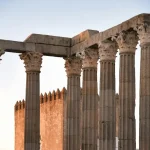
📷 Featured image by Nadya Filatova on Unsplash.