On this page
- Why Tomar Is Getting Harder to Visit Unprepared
- The Convento de Cristo: What You’re Actually Looking At
- The Charola: The Templar Rotunda That Defies Easy Description
- Beyond the Convent: Tomar’s Templar Footprint in the Town Below
- The Aqueduct, the Jewish Quarter, and the Layers of History Beyond the Knights
- Day Trip or Overnight? Honest Advice for 2026 Visitors
- Getting to Tomar in 2026
- Where to Eat in Tomar: Real Recommendations
- 2026 Budget Reality: What Tomar Costs
- Frequently Asked Questions
💰 Click here to see Portugal Budget Breakdown
💰 Prices updated: August, 2026. Budget figures are estimates — always verify before travel.
Exchange Rate: $1 USD = €0.86
Daily Budget (per person)
Shoestring: €40.00 – €90.00 ($46.51 – $104.65)
Mid-range: €130.00 – €200.00 ($151.16 – $232.56)
Comfortable: €250.00 – €500.00 ($290.70 – $581.40)
Accommodation (per night)
Hostel/guesthouse: €15.00 – €45.00 ($17.44 – $52.33)
Mid-range hotel: €100.00 – €190.00 ($116.28 – $220.93)
Food (per meal)
Budget meal: €10.00 ($11.63)
Mid-range meal: €35.00 ($40.70)
Upscale meal: €100.00 ($116.28)
Transport
Single metro/bus trip: €2.00 ($2.33)
Monthly transport pass: €40.00 ($46.51)
Why Tomar Is Getting Harder to Visit Unprepared
Tomar has quietly become one of central Portugal’s most visited historic sites, and in 2026 the Convento de Cristo now requires advance ticket booking during peak months. If you show up on a Saturday in July expecting to walk straight in, you may find yourself locked out or facing a two-hour queue. That’s the reality. This guide tells you exactly what to see, how long you need, what to eat, and how to get there without wasting half your day.
The Convento de Cristo: What You’re Actually Looking At
The Convento de Cristo sits on a wooded hill above the town of Tomar, and it is one of the most architecturally layered buildings in Europe. That is not an exaggeration. The structure spans roughly six centuries of construction, which means you’re looking at Romanesque, Gothic, Manueline, and Renaissance elements layered on top of each other in a single complex. The Knights Templar founded it in the 12th century. After the Templar order was dissolved in 1312, the Portuguese Crown folded them into a new order — the Order of Christ — and the convent became that order’s headquarters.
The result is a building where every generation of Portuguese power added something. King Manuel I funded the famous Manueline windows in the early 1500s. Henry the Navigator, who was governor of the Order of Christ, used the wealth from Portugal’s maritime expansion to fund extensions and cloisters. The complex has seven cloisters in total. Most visitors rush through three of them and miss the quieter ones entirely.
Plan at least two hours here. If you’re serious about history, three hours is more realistic. The audio guide is included in the entry price and is genuinely useful — better than the printed pamphlet.
The Charola: The Templar Rotunda That Defies Easy Description
Inside the convent, the Charola is the original Templar oratory — a 12th-century circular church modelled loosely on the Church of the Holy Sepulchre in Jerusalem. The Knights Templar were obsessed with that form. Standing inside it the first time produces a specific feeling: the octagonal interior rises around you in dark painted panels and gilded columns, the light falls in strange angles from the high windows, and the medieval frescoes — restored and partially surviving — press in from every side.
The smell of old stone and cool air is part of it too. Even on a hot July afternoon outside, the Charola stays cold. The acoustics are unusual: your footsteps carry oddly and voices flatten. It feels like a place designed to disorient in a deliberate way, which is probably the point.
Legend says the Knights Templar celebrated mass on horseback here, riding in circles around the central altar. Historians debate exactly how literally to take this, but the building’s layout makes it physically possible. The diameter is wide enough, the doors are tall enough, and the circular path around the altar is clear. Whether or not they actually did it, the image is hard to shake once you’ve stood inside.
The Charola connects directly to the nave added in the 16th century by King Manuel I, and the transition between the two spaces is jarring in a fascinating way — from a dark, Byzantine-feeling rotunda into a soaring Gothic nave with Manueline ornament exploding across every surface.
Beyond the Convent: Tomar’s Templar Footprint in the Town Below
The hill and the convent get all the attention, but the Templars also built the town of Tomar itself. Gualdim Pais, the Templar Master who founded the convent in 1160, laid out the town grid below it in a way that was unusually rational for 12th-century Iberia. The street pattern in the old town still largely follows that original plan.
The Castelo dos Templários sits immediately adjacent to the convent walls — the defensive castle the Templars built to protect their headquarters. The castle walls and tower are partly accessible and give you the clearest view of how the military and religious functions were integrated in a single hilltop complex. The Templars were a military order first, monks second, and the architecture makes that hierarchy obvious.
Down in the town, the Church of Santa Maria do Olival was the Templars’ mother church for all of Portugal — more important than the convent in organizational terms. Several Grand Masters of the Portuguese Templars are buried here. It’s a ten-minute walk from the old town centre, and it sees a fraction of the visitors the convent does. The interior is austere and Romanesque, which feels appropriate.
The Aqueduct, the Jewish Quarter, and the Layers of History Beyond the Knights
Tomar is a Templar town, but it’s also a town with a well-preserved Jewish quarter and a striking 16th-century aqueduct that most visitors walk past without registering.
The Judiaria — the old Jewish neighbourhood — sits in the historic centre and contains one of the best-preserved medieval synagogues in Portugal, the Sinagoga de Tomar. It was built in the 15th century and is now a small museum. After 1496, when King Manuel I expelled or forcibly converted Portugal’s Jewish population, the building was used for various other purposes over the centuries. The four Gothic stone columns inside are original. Entry is inexpensive and takes about 20 minutes.
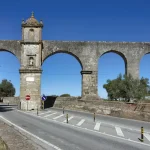
The Aqueduto de Pegões is less visited than it deserves to be. Built in the late 16th and early 17th centuries to supply the convent with water, it stretches for 6 kilometres and has sections with double-tiered arches. You can walk alongside part of it through the forest north of town. It’s a genuinely peaceful half-hour walk and makes a good contrast to the intensity of the convent interior.
Day Trip or Overnight? Honest Advice for 2026 Visitors
Tomar is 140 kilometres northeast of Lisbon and is genuinely doable as a day trip — but only if you leave Lisbon before 9:00 and focus your time tightly. A day trip realistically gives you the Convento de Cristo, the Charola, and a walk through the old town. That’s enough for many people.
If you want to visit Santa Maria do Olival, the Sinagoga, the aqueduct walk, and take a proper lunch, stay overnight. One night is sufficient. Tomar has a relaxed, unhurried quality in the evenings once the day-trip visitors leave. The Nabão River runs through town, and the riverside park area is pleasant at dusk.
Getting to Tomar in 2026
The most practical option from Lisbon is the direct CP Intercidades train from Lisboa Oriente. Journey time is approximately 1 hour 40 minutes. In 2026, CP runs four to five direct services per day in each direction, with more connections via Entroncamento. Check the CP website for current times — the schedule was adjusted in late 2025 and some earlier timetables floating around online are outdated.
From Porto, travel via Entroncamento with a change; total journey time is roughly 2 hours 30 minutes. There is no high-speed rail service to Tomar.
By car from Lisbon, take the A1 north and exit toward Tomar via the A23. Driving time is about 1 hour 30 minutes depending on traffic. Parking near the old town is free in several areas along the riverside. Driving up to the convent hill is possible — there is a car park near the entrance — but the road is narrow.
There is no direct bus service from Lisbon that’s competitive with the train. Rede Expressos buses exist but take longer and drop you outside the centre.
Where to Eat in Tomar: Real Recommendations
The local sweet you need to try is fatias de Tomar — thick egg-yolk pastry slices that are intensely sweet and yellow, tasting of sugar, egg, and cinnamon. They have the sticky density of a Portuguese convent sweet, which makes sense given the town’s history. The best place to buy them is Pastelaria Paraíso on Rua Serpa Pinto in the old town, where they’re made on-site and sold by the slice or box.
For lunch, Restaurante Tabuleiro on Rua Serpa Pinto serves honest central-Portuguese cooking — roast kid, bacalhau preparations, and good local wine. Portions are large. The dining room is plain and the service is straightforward. It’s the kind of place where the locals eat, which in 2026 is saying something in a town that gets significant tourist traffic.
If you want something lighter, the cafés around Praça da República do simple sandwiches and soup at reasonable prices. Sit outside if the weather allows — the square is attractive and calm in the mid-afternoon.
2026 Budget Reality: What Tomar Costs
- Convento de Cristo entry (2026): approximately €8 per adult, with discounts for EU citizens under 26 and seniors. Audio guide included.
- Sinagoga de Tomar: free entry, donations welcomed.
- Train from Lisbon (single): €13–€16 depending on class and booking timing.
- Budget accommodation (guesthouses, pensões): €40–€65 per night for a double room.
- Mid-range hotel: €75–€110 per night. The Hotel dos Templários near the river is the most comfortable option in town at around €95–€115.
- Lunch (sit-down, full meal): €12–€18 per person including a glass of wine.
- Fatias de Tomar (box of six): approximately €5–€7.
Tomar remains one of central Portugal’s better-value day trips from Lisbon. The train ticket and convent entry combined cost less than €30, and you can eat well for under €20. Even an overnight stay with accommodation and meals is comfortably under €150 per person for a mid-range budget.
Frequently Asked Questions
How long do you need in Tomar?
A focused day trip covers the Convento de Cristo, Charola, and old town in about six to seven hours. If you want to visit the synagogue, aqueduct, and Santa Maria do Olival without rushing, plan an overnight stay. Two days is generous but leaves you fully satisfied rather than feeling like you skimmed.
Do you need to book Convento de Cristo tickets in advance?
In 2026, advance booking is strongly recommended from June through September and on weekends year-round. The site uses the national heritage booking portal. Walk-up entry is still available at off-peak times, but slot availability during summer is limited. Booking 48 hours ahead is usually sufficient outside of July and August.
Is Tomar suitable for children?
Yes, with some caveats. The Charola and castle walls genuinely impress older children interested in history. The convent is large and requires a lot of walking on uneven stone surfaces. Younger children may find the interior visits long. The riverside park and town square are good places to decompress after the convent.
What is the best time of year to visit Tomar?
April, May, October, and November offer the best combination of mild weather, manageable crowds, and lower accommodation prices. The famous Festa dos Tabuleiros takes place every four years — the next edition after 2023 will be in 2027 — which transforms the town and requires planning significantly further ahead.
Can you visit Tomar without a car?
Easily. The CP train from Lisbon is direct and drops you within walking distance of the old town. The convent hill is a 15-minute uphill walk from the station, or a short taxi ride. Almost all the key sites are walkable from the centre. A car is useful only if you want to explore the aqueduct sections further into the surrounding countryside.
📷 Featured image by Geike Verniers on Unsplash.