On this page
- Quinta da Regaleira’s Lesser-Known Corners
- Monserrate Palace: Sintra’s Most Overlooked Treasure
- Convento dos Capuchos: The Cork Monastery in the Forest
- Peninha Sanctuary and the Atlantic Clifftops
- Eugaria Village and the Colares Wine Country
- Azenhas do Mar: The Sea Pools Most Tourists Never Find
- Sintra Village After the Day-Trippers Leave
- 2026 Budget Reality: What These Hidden Gems Cost
- Practical Tips for Getting to Sintra’s Hidden Spots
- Frequently Asked Questions
💰 Click here to see Portugal Budget Breakdown
💰 Prices updated: August, 2026. Budget figures are estimates — always verify before travel.
Exchange Rate: $1 USD = €0.86
Daily Budget (per person)
Shoestring: €40.00 – €90.00 ($46.51 – $104.65)
Mid-range: €130.00 – €200.00 ($151.16 – $232.56)
Comfortable: €250.00 – €500.00 ($290.70 – $581.40)
Accommodation (per night)
Hostel/guesthouse: €15.00 – €45.00 ($17.44 – $52.33)
Mid-range hotel: €100.00 – €190.00 ($116.28 – $220.93)
Food (per meal)
Budget meal: €10.00 ($11.63)
Mid-range meal: €35.00 ($40.70)
Upscale meal: €100.00 ($116.28)
Transport
Single metro/bus trip: €2.00 ($2.33)
Monthly transport pass: €40.00 ($46.51)
In 2026, Sintra‘s main circuit — Pena Palace, the National Palace, a quick espresso on Volta do Duche — is more crowded than ever. The town receives over four million visitors a year, and on summer weekends the queues at Pena stretch past an hour before the gates even open. If that’s the Sintra you came for, you’ll find it. But Sintra’s real magic lives in the places most visitors never reach: quiet forest paths, clifftop chapels, wine-soaked villages, and palaces where you might be the only person in the room. This guide is for that version of Sintra.
Quinta da Regaleira’s Lesser-Known Corners
Most people who visit Quinta da Regaleira spend their entire visit at the Initiation Well — that stunning spiral staircase descending into the earth — take their photos, and leave. The well deserves the attention it gets. But the estate sprawls across four hectares of dense woodland, and the majority of it sees almost no foot traffic even on the busiest days.
Walk past the well and follow the path toward the upper terraces. You’ll find a second, smaller inverted tower called the Unfinished Well — far less dramatic but completely empty of visitors and ringed by moss-covered stones. Further along, the Chapel of the Holy Trinity is a genuinely eerie space: dim, layered with esoteric symbols, and most visitors walk past it entirely because there’s no sign pointing to it from the main entrance route.
The estate’s eastern woodland paths wind through grottos, artificial lakes, and decorative towers. In spring, the humidity makes the air thick with the smell of wet fern and eucalyptus. In the right season you’ll hear running water from the estate’s hidden stream systems before you see them. Arrive when the gates open at 09:30 and go directly past the crowds heading to the well. You’ll have the upper gardens nearly to yourself for the first 40 minutes.
Monserrate Palace: Sintra’s Most Overlooked Treasure
Pena gets all the postcards, but serious architecture lovers consistently say Monserrate is the more interesting building. It was rebuilt in the 1850s by British merchant Sir Francis Cook, who hired James Knowles Jr. to design a palace that blends Gothic, Moorish, and Indian influences into something that shouldn’t work but completely does. The interior rooms — especially the Music Room with its Indo-Gothic ceiling — feel genuinely extraordinary, not just photogenic.
The real underrated feature is the botanical garden surrounding it. Cook spent decades importing plants from across the world, and what grew in Sintra’s unusual microclimate (cool, wet, filtered Atlantic light) is remarkable. The garden has over 3,000 plant species. Paths run through Mexican desert plants placed 10 metres from New Zealand tree ferns, with Japanese cedars rising above both. The garden is partially mapped and partially wild, with sections that feel genuinely unmaintained.
Monserrate sits about 3.5 kilometres west of Sintra village along the Estrada de Monserrate. The tourist bus Line 435 stops here, but on weekdays the palace attracts perhaps 10% of the visitors that Pena does. Admission in 2026 costs €10 for the palace and gardens combined — one of the best value tickets in the Sintra circuit.
Convento dos Capuchos: The Cork Monastery in the Forest
Nothing in Sintra prepares you for the Capuchos Convent. It was built in 1560 by Franciscan monks who took the vow of poverty so seriously that they lined every cell, corridor, and doorway with cork — both for insulation against Sintra’s damp winters and as a constant reminder of humility. Walking through it feels less like visiting a monument and more like entering a dream that someone built inside a forest.
The cells are barely large enough to lie down in. Door frames are so low you have to duck through every single one. The whole complex is built into a granite outcrop, so rooms have natural rock ceilings and walls where the builders simply worked around the stone. Lord Byron visited in 1809 and called it the most beautiful desolation he had ever seen. The description still holds.
Capuchos is 8 kilometres from Sintra village, up in the Serra de Sintra forest. The tourist bus Line 435 doesn’t reach it — you need a car, taxi, or the Sintra Hills hiking trail that connects to it from Pena Park (about 5 kilometres of forest walking). This is specifically why most day-trippers skip it. Those who make the effort find a place that’s simultaneously one of the most unusual monuments in Portugal and almost always quiet. Admission is €8 in 2026.
Peninha Sanctuary and the Atlantic Clifftops
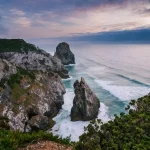
At 486 metres above sea level on the western edge of the Serra de Sintra, Peninha sits higher than Pena Palace and offers something Pena cannot: an unobstructed view straight out over the Atlantic. On clear days you can see the coastline running south toward Cascais and north past Ericeira. On foggy mornings — which are frequent in Sintra — the sanctuary appears to float above a white sea of cloud, the Atlantic visible in the gap below, and the hilltops of the Serra poking through above you.

The sanctuary itself is a small 17th-century chapel dedicated to Nossa Senhora da Penha. It’s often locked on weekdays, but the outer terrace and the rocky escarpments around it are completely open and free to access. The drive up from Sintra takes about 20 minutes along a winding road through eucalyptus forest. There’s a small car park at the top. This is one of the few places in greater Sintra where you can sit on a rock at the edge of the world with a coffee from your thermos and hear nothing but wind.
Peninha is not on any tourist bus route. A taxi from Sintra village costs around €15–18 each way. Some of Sintra’s better hiking routes connect through here — the GR11 trail passes close by if you’re walking from the village.
Eugaria Village and the Colares Wine Country
Five kilometres north of Sintra on the coastal side of the Serra, the landscape drops into a different world entirely. The parish of Colares is one of the only wine-growing regions in Europe where the vines survived the 19th-century phylloxera epidemic — the sandy soil meant the root-destroying louse couldn’t get purchase. The Ramisco grape variety still grows here on its original pre-phylloxera rootstock, which makes Colares wine genuinely rare on a global scale.
The village of Eugaria sits inside this protected wine zone. It’s the kind of place where old men sit outside the single café in the afternoon and the only sounds are a distant tractor and chickens somewhere behind a wall. The Adega Regional de Colares, the local cooperative winery, operates a small shop on the edge of the village where you can taste and buy bottles of red Colares for €12–25 depending on vintage. The wine is austere, mineral, with tannins that catch the back of your tongue — nothing like a modern smooth red.
From Sintra village, drive or take the 441 bus toward Colares. Eugaria is signposted off the main road. Allow half a day: the village, the cooperative, and a walk through the vine plots takes two to three hours, and the road west from Eugaria drops you directly to the Praia de Azenhas do Mar coastline.

Azenhas do Mar: The Sea Pools Most Tourists Never Find
From the clifftop road above it, Azenhas do Mar looks almost impossible — a cluster of white houses stacked against a sheer ochre cliff face, with a natural sea pool carved into the rock at the base where the Atlantic crashes in on three sides. The village has about 300 permanent residents and one restaurant that has been serving grilled fish on the same terrace for decades. The sea pool is free, open in summer months, and fills with cold Atlantic water that comes in at around 17–18°C even in August.
The access road is steep and narrow. The car park at the top fills quickly on summer weekends, but if you arrive before 10:00 or after 17:00 you’ll have little trouble. The path down to the pool is about 5 minutes of steps. The pool itself isn’t polished — the rocks are real, the seaweed is present, and the waves occasionally send a sheet of spray across the whole area. That’s the point. It’s one of the last genuinely unmanicured sea experiences on the Lisbon coastal circuit.
There’s a small bar-restaurant, O Negrão, right on the clifftop with a terrace view that hits differently after a swim. A plate of percebes (barnacles) with a cold Sagres costs around €18–22 total. From Sintra village, the 441 bus runs to Azenhas do Mar but only a few times per day — check the Scotturb timetable before you go.
Sintra Village After the Day-Trippers Leave
By 18:00 on any day between April and October, something shifts in Sintra village. The tour buses have gone. The souvenir shops pull their shutters. The streets that were impassable at noon — Rua das Padarias, the lanes around the National Palace — become genuinely navigable. The light in the late afternoon turns gold and falls diagonally through the narrow passages of the historic centre in a way that has nothing to do with the postcard version of Sintra.
The cafés that were too crowded to enter at lunchtime have seats available. Casa Piriquita, the bakery on Rua das Padarias known for its travesseiros (puff pastry pillows filled with almond cream) and queijadas (small cheese tarts), slows down enough that you can actually stand at the counter and watch the staff box up the pastries still warm from the kitchen. The sugar-dusted pastry shell of a travesseiro cracks when you bite into it, releasing a dense hit of egg yolk and almond that explains exactly why people queue for them in the first place.
Two restaurants worth the evening stay: Tascantiga on Rua Dr. Alfredo Costa does small plates of Portuguese food at honest prices in a room that fits maybe 30 people. Solar de São Pedro in the village of São Pedro de Sintra (a 15-minute walk from the centre) has been feeding locals and quiet travellers for years with proper regional dishes. Both require reservations in high season.
2026 Budget Reality: What These Hidden Gems Cost
One advantage of going off the main circuit is that the prices reflect it. Here’s what to expect in 2026:
- Quinta da Regaleira: €15 adults, under 6 free. Timed entry required — book online.
- Monserrate Palace and Gardens: €10 adults, €8.50 reduced. Excellent value for what you get.
- Convento dos Capuchos: €8 adults. No advance booking needed on most weekdays.
- Peninha Sanctuary: Free. Access to the clifftop area costs nothing.
- Colares Wine Cooperative tasting: €5–8 for a guided tasting of 3 wines. Bottles from €12.
- Azenhas do Mar sea pool: Free in shoulder season, €3 entry fee applies June–August.
Budget traveller daily spend in Sintra (2026): €30–45, covering transport from Lisbon by train (€2.60 each way on the CP Sintra line), one or two attraction entries, lunch at a local café, and a coffee and pastry.
Mid-range day: €70–100, adding a sit-down dinner in the village, a taxi to Capuchos or Peninha, and a wine tasting in Colares.
Comfortable: €130–180, including a night in one of Sintra’s small historic guesthouses, a private driver for the day, and dinner at a proper restaurant with wine.
Practical Tips for Getting to Sintra’s Hidden Spots
Transport Realities in 2026
The CP train from Lisboa Rossio to Sintra runs every 20–30 minutes and takes about 40 minutes. It costs €2.60 with a Viva Viagem card loaded from any station machine. This is by far the fastest and cheapest way to arrive. In 2026, driving to Sintra on weekends in summer is actively discouraged — the town has introduced vehicle access restrictions on Saturday and Sunday between June and September, requiring a permit for non-residents to enter the historic centre by car.
Within Sintra, the tourist bus lines 434 and 435 cover the main palace circuit. Line 434 goes to Pena and Moorish Castle; Line 435 covers Monserrate and points west. Day passes cost €15. Taxis and Ubers are available from the station rank but prices to remote spots like Capuchos or Peninha add up fast. For the coastal villages (Azenhas do Mar, Colares), the 441 bus from Sintra operates a limited schedule — check Scotturb’s 2026 timetable online before planning.
What to Bring
Sintra’s microclimate is real and genuinely different from Lisbon. Even on a day when Lisbon is 28°C and sunny, Sintra can be 20°C with cloud cover and a damp wind. Bring a layer regardless of the season. Comfortable walking shoes are essential — the forest paths at Capuchos and Regaleira are uneven. For Azenhas do Mar, bring a towel and water shoes if you plan to use the sea pool.
Timing
Weekdays in October, November, and March are the closest Sintra gets to a quiet experience. July and August are unavoidable for some travellers — if that’s you, the early start strategy is non-negotiable. At the popular sites, arriving 30 minutes before opening makes a meaningful difference. For the coastal and rural spots in this guide, weekends in summer are fine because the crowds simply don’t go there.
Frequently Asked Questions
How do I get from Lisbon to Sintra’s hidden attractions without a car?
The CP train from Rossio gets you to Sintra in 40 minutes for €2.60. From there, tourist buses 434 and 435 cover Regaleira and Monserrate. For Capuchos and Peninha, you’ll need a taxi or to join a small-group tour. For the coastal villages, the 441 bus runs limited services — check Scotturb’s schedule in advance.
Is Sintra worth visiting in winter?
Yes, and arguably more so than summer for off-the-beaten-path exploration. From November through February, crowds drop dramatically, prices at guesthouses fall by 30–40%, and the forest landscapes around Capuchos and Regaleira take on an atmospheric mist that genuinely suits them. Some minor attractions reduce hours, so check opening times before visiting.
What’s the best hidden viewpoint in Sintra that most tourists miss?
Peninha Sanctuary on the western edge of the Serra is Sintra’s most overlooked high point. It’s free to access, not on any tourist bus route, and on clear days offers some of the most dramatic coastal views in all of western Portugal.
Is Colares wine worth seeking out?
For wine-curious travellers, yes. Colares is one of Europe’s rarest wine denominations — still made from pre-phylloxera Ramisco vines in sandy coastal soil. The wine style is old-fashioned and distinctive; it’s not for everyone, but it’s genuinely unlike anything else in Portugal.
How much time do I need to explore Sintra beyond the main palaces?
To see Regaleira properly, visit Monserrate, and reach Capuchos, you need a minimum of two full days. Adding the coastal villages and Peninha realistically means three days total. Many travellers staying in Sintra overnight rather than day-tripping from Lisbon discover this naturally — the town changes completely once the day-trip crowds leave.
📷 Featured image by Marina Lala on Unsplash.