On this page
- The Algarve Coast on Foot
- Best Bases for Walkers
- The Best Coastal Walks by Level
- Where to Eat Before and After a Walk
- Getting to the Trailheads
- Day Trips to Pair With Your Walks
- Evenings After the Trail
- Gear and Shopping
- Accommodation by Budget
- Best Time to Walk
- Practical Tips
- 2026 Budget Breakdown
- Frequently Asked Questions
💰 Click here to see Portugal Budget Breakdown
💰 Prices updated: November, 2026. Budget figures are estimates — always verify before travel.
Exchange Rate: $1 USD = €0.89
Daily Budget (per person)
Shoestring: €50.00 – €85.00 ($55.96 – $95.13)
Mid-range: €130.00 – €340.00 ($145.50 – $380.53)
Comfortable: €350.00 – €1,020.00 ($391.72 – $1,141.58)
Accommodation (per night)
Hostel/guesthouse: €15.00 – €45.00 ($16.79 – $50.36)
Mid-range hotel: €100.00 – €190.00 ($111.92 – $212.65)
Food (per meal)
Budget meal: €12.00 ($13.43)
Mid-range meal: €28.00 ($31.34)
Upscale meal: €110.00 ($123.11)
Transport
Single metro/bus trip: €1.90 ($2.13)
Monthly transport pass: €40.00 ($44.77)
The photo that sends most visitors to the Algarve is a golden cliff over turquoise water. The reality in July is a full car park at 9:30 a.m., 34°C heat and a trail with almost no shade. In 2026 the best coastal walking still exists, but it rewards people who plan the timing, the direction and the transport. This guide matches routes to your fitness level, tells you how to reach each trailhead, and shows what a walking week really costs.
The Algarve Coast on Foot
The Algarve has two walking personalities. The western and central coast, called the Barlavento, is all limestone: ochre cliffs, sea stacks, hidden coves and caves that boom when the Atlantic pushes in. The eastern coast, the Sotavento, is flat and calm. Barrier islands, salt pans and lagoon boardwalks replace the drama.
On a cliff path you walk through the smell of rock rose and wild thyme, warmed by the sun. Gravel crunches under your boots and the wind carries salt. On an eastern boardwalk you hear wading birds in the Ria Formosa lagoon and your own footsteps on timber planks. Neither is better. Most walkers do both over a week.
The paths themselves are mostly informal fishermen’s tracks. Some are signed and well kept, like the Seven Hanging Valleys Trail and the Rota Vicentina’s Fishermen’s Trail. Others are a dirt line along a cliff edge with no signs at all. Knowing which is which is half the skill.
Best Bases for Walkers
Lagos: best all-rounder
Lagos is walkable, has a train station and plenty of restaurants, and sits beside Ponta da Piedade, the Luz–Burgau coast and the start of the Sagres routes. It suits first-timers and people travelling without a car.
Carvoeiro and Lagoa: best for the famous trail
Carvoeiro is a small fishing village turned resort. It puts you close to the Seven Hanging Valleys Trail and Algar Seco. It is quieter than Albufeira and suits couples and mid-range travellers who have a car or accept short taxi hops.
Sagres and Vila do Bispo: best for wild walking
Sagres is windy and a little rough around the edges. It is also the best base for the Cabo de São Vicente cliffs and the start of the Rota Vicentina’s Fishermen’s Trail. It suits fit walkers and surfers who want empty paths at sunrise.
Tavira: best for gentle walking
Tavira is a riverside town of white houses and Roman bridges, with the Ilha de Tavira beach and Cacela Velha nearby. It has trains from Faro and a calm pace, so it works for families and older walkers.

Olhão and Faro: best for the lagoon
These two are gateways to the Ria Formosa Natural Park. Boats leave for the islands, and the flat paths suit anyone who dislikes cliffs. Faro is also practical because of the airport.
The Best Coastal Walks by Level
Easy: under 3 hours, flat or gently rolling
Ponta da Piedade, Lagos. From the old town, walk past Praia Dona Ana to the headland, about 2.5 km each way. Allow 1.5 to 2 hours with stops. Wooden walkways lead to viewpoints over golden rock stacks. If you want to go down, around 200 steps lead to a small landing where boats collect visitors for cave tours. Late afternoon gives the warmest colour, and the headland is much calmer after the tour boats stop.
Alvor Boardwalks. About 6 km of timber walkways run through the Ria de Alvor wetlands and dunes. They are flat, signed and good for children. Start in Alvor village and walk toward the sea. Egrets and other waders feed in the channels at low tide. Bring a hat, because there is little shade.
Ria Formosa boardwalks near Quinta do Lago. Timber paths cross the lagoon edge and the dunes toward the beach, about an hour at a relaxed pace. Early morning is best, when the water is still and the light is soft.
Praia da Falésia. Between Olhos de Água and the Vilamoura side, red, ochre and white cliffs rise above a long, wide beach. At low tide you can walk the sand for several kilometres. At high tide the beach narrows, so check tide times first. This is one of the most photogenic easy walks in the region.
Moderate: 3 to 5 hours, some ups and downs
Seven Hanging Valleys Trail (Praia da Marinha to Vale Centeanes). The headline route covers about 5.7 km each way. Allow 2 to 2.5 hours one way, longer if you photograph every cove. It passes Praia da Marinha, the area above the Algar de Benagil, Praia de Benagil and Praia do Carvalho, and ends near Carvoeiro. The path is wide and mostly clear, but it runs very close to cliff edges and has almost no shade. Walk it early or late. Many people do it one way and take a taxi back.

Burgau to Salema. This stretch is much quieter than the Lagoa coast. Luz to Burgau is short, around 3 to 4 km, and the longer section from Burgau to Salema is about 6 to 7 km of open cliff, small ravines and wide views. Grilled fish in Salema is the reward. The route is less signed than the famous trails, so use an offline map.
Sagres to Cabo de São Vicente. About 6 km one way along cliffs at the south-western tip of mainland Europe. Wind is the main challenge, and it can be strong enough to flatten you on exposed sections. You pass the Sagres Fortress and finish at the lighthouse. Go late in the day if you want the sunset.
Challenging: full day, long or demanding stages
Rota Vicentina Fishermen’s Trail stages. The Algarve section runs along the wild west coast. Stages such as Arrifana to Carrapateira or Carrapateira to Vila do Bispo are generally 15 to 20 km, over dunes, cliffs and sandy tracks. Soft sand makes distances feel longer. Services are limited and phone signal drops in places. Carry food and at least 2 litres of water per person. Because transport between stages is awkward, many walkers book a baggage and transfer service or stay in villages.
Carrapateira area loops. If a full stage sounds too much, local circular routes around Carrapateira cover roughly 8 to 10 km. They take in the Bordeira dunes, Amado clifftops and wide beaches. It is a good taste of the wild coast without a long transfer.
Where to Eat Before and After a Walk
Lagos. Visit the municipal market early for fruit, bread, cheese and olives. Buy the walking snack basket here: figs, almonds, a hunk of bread. After Ponta da Piedade, head to the streets around Rua 25 de Abril and Rua Silva Lopes for grilled fish and tapas-style plates.
Tavira. The Mercado da Ribeira, in a restored riverside building, has food stalls and snacks. For a proper sit-down lunch, the riverside streets, especially around Rua José Pires Padinha, have grilled sea bream, clams and octopus.

Olhão. The two red-brick market halls beside the marina sell fish and produce. Plain waterfront restaurants nearby grill whatever came off the boats that morning. Eating here before a boat to Culatra or Armona is a pleasure.
Sagres and Salema. The best places are simple, family-run seafood spots near the harbours. Look for tables full of locals and the smell of charcoal grills. In Sagres, ask whether percebes (goose barnacles) are available. They are expensive and come from the cliffs you have just walked.
On the trail. Many cliff walks have no cafés, so beach kiosks at Marinha, Benagil, Dona Ana and Salema are your refuelling points. Carry cash for small kiosks, though card payment is now common.
Getting to the Trailheads
From Faro Airport. The airport is the main gateway. Passport checks can take longer since the EU’s new Entry/Exit System began rolling out in late 2025, so build in extra time on departure day. For Lagos, regional buses and trains via Faro take roughly 1h45 to 2h15 and cost around €8 to €13. A taxi or ride-hail to Lagos costs about €90 to €110. To Albufeira it is about €45 to €60.
Buses. The regional network, branded Vamus Algarve, links Lagos, Sagres, Portimão, Albufeira and Faro. Fares are low, around €4 to €6 for Lagos to Sagres. Services thin out sharply on Sundays and in winter, so check times the day before.
Trains. CP’s Algarve line runs from Lagos through Portimão and Faro to Tavira and Vila Real de Santo António. It is the best way to reach the Lagos and Tavira bases without a car. Some stations, including Albufeira’s, sit well inland, so you still need a bus or taxi.
Taxis and ride-hailing. Taxis are easiest for one-way walks. Ride-hail apps work in the main towns but can be unreliable at remote trailheads, so book a taxi for the return when possible.
Car hire. A car gives the most freedom, especially for the west coast. Expect roughly €25 to €50 per day outside summer and €60 to €100 in July and August. Some cliff car parks fill quickly and fines for illegal parking are real.
Day Trips to Pair With Your Walks
- Silves (45 minutes from Lagos by car, 1 to 2 hours by bus or train plus connection). Red sandstone castle, Moorish history and quiet river views. Half a day is enough.
- Monchique and Fóia (about 45 minutes by car from Portimão or Lagos). At 902 m, Fóia is the highest point in the Algarve. It is cooler in summer and offers inland forest walks. Allow a full day.
- Cacela Velha (about 25 minutes by car from Tavira). A tiny whitewashed village above the lagoon. Walk down to the beach at low tide. Two to three hours is plenty.
- Ilha Deserta or Culatra (ferry from Faro or Olhão, 20 to 45 minutes depending on route). Sand, quiet boardwalks and swimming. A relaxing day after a hard hike, with return ferries costing roughly €10 to €20 depending on the route.

Evenings After the Trail
Lagos has the liveliest bar streets for walkers: Rua 25 de Abril and Rua Lançarote de Freitas fill with live music, cocktail bars and late-night tapas. Tavira is quiet. Expect riverside drinks, small live music venues in summer and a stroll over the Roman bridge. Sagres is a surf-town evening with beer, a sunset by the fortress and early nights. Albufeira‘s Strip around Rua Cândido dos Reis is loud and built for party crowds, so avoid it if you plan to hike at 7 a.m. Faro has a small old-town bar scene and student crowds in term time.
Gear and Shopping
Shoes matter more than anything. Trail runners with grip or light hiking boots work best. Sandals are a poor choice on loose limestone. Bring a hat, sunglasses and high-SPF sunscreen, even in March.
If you forgot something, Decathlon has branches in the Portimão and Faro areas, and local shops in Lagos sell hats, water bottles and swimwear. Lagos old town has small boutiques for linen, ceramics and cork goods. The Loulé municipal market, a Moorish-style building, is good for local honey, dried fruit and almonds, with a bigger street market on Saturdays. Algarve cork bags and copper cataplana pans are the classic souvenirs.
Accommodation by Budget
- Budget (€25 to €70 per night): Hostel dorms in Lagos and Faro cost around €25 to €40 in shoulder season and more in summer. Simple guesthouses in Tavira and Sagres start around €50 to €70.
- Mid-range (€90 to €170 per night): Boutique guesthouses and small hotels in Lagos, Tavira and Carvoeiro. Breakfast is often included, and many have pools.
- Luxury (€200 to €450+ per night): Clifftop resorts around Lagoa and Carvoeiro, and designer hotels near Sagres and Tavira. Summer rates can double.

Book early for July and August. For September and October, one to two months ahead is usually enough, but small guesthouses near the Rota Vicentina can fill quickly.
Best Time to Walk
Spring (March to May) is the sweet spot. Temperatures sit around 18°C to 24°C, wildflowers cover the cliffs and the trails are quieter. Autumn (September to November) is warm, 22°C to 28°C in September, with calmer seas and fewer crowds.
Summer (June to August) brings 30°C to 35°C and strong sun. Walk at sunrise or after 6 p.m. During high fire-risk periods, authorities can restrict access to some forest and countryside areas, so check local alerts. Winter (December to February) averages 12°C to 17°C by day with rain, but there are many clear days. January and February can bring almond blossom in inland areas.
Festivals to time around include Loulé’s Carnival in February, the Festival do Marisco in Olhão in August, and the sardine festival season in Portimão in summer.
Practical Tips
- Cliff safety: The edges are unstable. Stay well back from the edge, ignore any selfie spots that look crumbling, and never walk under overhanging cliffs. Heed warning signs on beaches, because rockfalls happen.
- Water and sun: Carry at least 1.5 to 2 litres per person on short routes and more on long ones. Tap water in towns is safe to drink, so refill bottles before you leave.
- Phone signal: It drops on parts of the west coast. Download offline maps. Emergency number: 112.
- SIM cards: Prepaid SIMs from Vodafone, MEO or NOS cost roughly €10 to €20 for a few weeks of data. eSIMs are also easy to set up.
- Tipping: Not required. Rounding up or leaving 5% to 10% for good service is normal.
- Language: English is widely spoken in tourist areas. A simple “bom dia” (good morning) and “obrigado/obrigada” (thank you) go a long way.
- Opening hours: Many restaurants close between about 3 p.m. and 7 p.m., and some close on Mondays in off-season. Shops may close for a long lunch in smaller towns.
- Leave no trace: Take your rubbish with you and stay on marked paths to protect dune vegetation.

2026 Budget Breakdown
These are estimates per person per day, based on typical shoulder-season prices. Summer is higher.
- Budget (about €55 to €85): Hostel dorm or simple room (€25 to €45), bakery breakfast (€3 to €5), market lunch or snack (€6 to €10), simple dinner (€10 to €16), local buses (€5 to €10).
- Mid-range (about €130 to €210): Guesthouse or small hotel (€90 to €140 per room, split if two people share), cafés and sit-down lunch (€15 to €25), seafood dinner with wine (€25 to €40), taxis or part-day car hire (€20 to €50), occasional boat tour (€25 to €35).
- Comfortable (about €250 to €450+): Boutique or clifftop hotel (€200 to €400), tasting menu or premium seafood dinner (€50 to €90), private transfers or full car hire (€50 to €100), guided walks or private boat trips (€40 to €120).
Extra costs include Sagres Fortress entry at around €3 to €4, paid parking at busy beaches and ferry fares to the Ria Formosa islands.
Frequently Asked Questions
What is the best coastal walk in the Algarve?
The Seven Hanging Valleys Trail between Praia da Marinha and Vale Centeanes is the most popular, with dramatic cliffs and hidden beaches over about 5.7 km each way. For quieter scenery, try Burgau to Salema or the Rota Vicentina’s Fishermen’s Trail on the wild west coast.
Can you walk the Algarve coast without a car?
Yes, in many areas. Lagos has walks from the town centre, and Tavira and Faro connect to the Ria Formosa by train or boat. For one-way routes like the Seven Hanging Valleys, combine walking with a short taxi or bus. The west coast stages are harder without a car.
Is the Seven Hanging Valleys Trail difficult?
It is moderate rather than hard. The path is mostly wide and gentle, but it has some ups and downs, loose gravel and very little shade. The real risk is heat, so walk early or late and carry plenty of water.
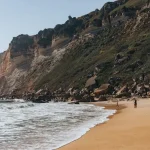
📷 Featured image by Sharad kandoi on Unsplash.