On this page
- Porto in 2026: Still Worth the Hype, But Only If You Know Where to Look
- Livraria Lello: The Bookshop That Earns Every Bit of the Queue
- Dom Luís I Bridge: Two Cities, One Iron Arch
- Ribeira District: A Neighbourhood That Is Itself the Attraction
- São Bento Train Station: History Told in 20,000 Tiles
- Palácio da Bolsa: The Interior Porto Keeps Underplaying
- Igreja de São Francisco: Gothic Gold in a Dark Church
- Foz do Douro: Where the River Finally Reaches the Sea
- Serralves Museum and Park: Contemporary Art in 18 Hectares of Forest
- Clérigos Tower: Porto’s Original Viewpoint
- Porto Wine Lodges of Vila Nova de Gaia: The Reason the City Has Its Name
- Matosinhos: Salt Air, Live Fire, and the Catch of the Morning
- Casa da Música: A Building Worth the Trip on Its Own
- Mercado do Bolhão: The Renovated Market and Its Complicated Reputation
- Afurada: The Fishing Village Porto Forgot to Promote
- The Best Miradouros: Four Viewpoints That Each Show a Different City
- 2026 Budget Reality: What These Attractions Actually Cost
- Frequently Asked Questions
💰 Click here to see Portugal Budget Breakdown
💰 Prices updated: September, 2026. Budget figures are estimates — always verify before travel.
Exchange Rate: $1 USD = €0.88
Daily Budget (per person)
Shoestring: €40.00 – €70.00 ($45.45 – $79.55)
Mid-range: €150.00 – €300.00 ($170.45 – $340.91)
Comfortable: €400.00 – €1,000.00 ($454.55 – $1,136.36)
Accommodation (per night)
Hostel/guesthouse: €15.00 – €50.00 ($17.05 – $56.82)
Mid-range hotel: €70.00 – €150.00 ($79.55 – $170.45)
Food (per meal)
Budget meal: €10.00 ($11.36)
Mid-range meal: €25.00 ($28.41)
Upscale meal: €60.00 ($68.18)
Transport
Single metro/bus trip: €1.90 ($2.16)
Monthly transport pass: €40.00 ($45.45)
Porto in 2026: Still Worth the Hype, But Only If You Know Where to Look
Porto has a problem most cities would kill for: too many people know about it. Since Booking.com and every major travel publication spent the better part of a decade calling it Europe’s best city break, the Ribeira waterfront now has more selfie sticks than fishing boats on a Saturday afternoon. But here’s what those listicles keep getting wrong — Porto’s best experiences are not the ones easiest to photograph. The city rewards people who slow down, walk uphill, and ignore the crowds heading toward the obvious. This guide covers 15 attractions worth your actual time, including a few that most visitors fly home without ever seeing.
Livraria Lello: The Bookshop That Earns Every Bit of the Queue
Livraria Lello on Rua das Carmelitas opened in 1906 and has been called one of the most beautiful bookshops in the world so many times that it almost sounds like marketing. It isn’t. The Art Nouveau interior — that sweeping red double staircase, the carved wooden balconies, the stained glass skylight throwing coloured light across shelves of Portuguese literature — stops most people dead in their tracks the moment they step inside. The smell alone is worth noting: old paper, wood polish, and something faintly damp from the stone walls.
The timed-entry system introduced around 2023 has matured well by 2026. Maximum capacity is managed strictly, which means you get a genuine moment inside rather than being crushed by a tour group. The bookshop sells Portuguese titles, international fiction, and quality travel books — the ticket credit makes picking something up a reasonable deal. Don’t rush out. Stand on the upper balcony and look down at the ground floor. That view is why photographers keep coming back.

Dom Luís I Bridge: Two Cities, One Iron Arch
Gustave Eiffel’s engineering office designed Dom Luís I Bridge, completed in 1886, and it remains one of the most functional pieces of landmark infrastructure in Europe — functional being the key word. This is not a bridge you admire from a distance. You cross it, twice if you have the legs for it. The lower deck carries pedestrians and cars across the Douro at river level. The upper deck, at 60 metres above the water, carries the Metro Line D and a narrow pedestrian walkway that delivers one of the city’s most honest views: Ribeira on your left, the wine lodges of Gaia on your right, the river wide and brown below you.
Cross the upper deck on foot even if you arrive by Metro. The wind picks up midway across, the iron vibrates faintly underfoot, and the whole city opens up around you. At sunset, the light turns the Douro copper. This is not an exaggeration — locals still stop to look.
Ribeira District: A Neighbourhood That Is Itself the Attraction
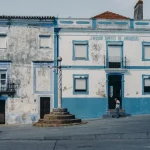
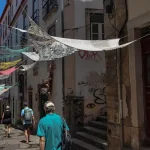
UNESCO listed Ribeira as a World Heritage site in 1996, but that designation misses what makes it worth your time in 2026. This is not a preserved relic — it is a lived-in, densely layered waterfront neighbourhood where medieval buildings lean at angles that defy gravity, laundry hangs between windows, and the cobblestones are uneven enough to require your full attention. The streets running back from the quay — Rua da Fonte Taurina, Beco das Flores, the alleys climbing toward Morro da Sé — are where the character lives.

The quayside itself (Cais da Ribeira) is tourist-heavy and the restaurant menus are priced accordingly. Walk one block inland and the atmosphere changes completely. The neighbourhood works best on weekday mornings before the tour boats start running, or on Sunday evenings when the day-trippers have gone home and locals actually use the space again.
São Bento Train Station: History Told in 20,000 Tiles
São Bento is a working railway station, not a museum, which is exactly what makes it extraordinary. Built on the site of a 16th-century convent and opened in 1916, the grand entrance hall is covered floor-to-ceiling in 20,000 azulejo panels painted by Jorge Colaço. The panels depict scenes from Portuguese history — medieval battles, royal processions, rural life — in a blue-and-white visual narrative that takes your eyes ten minutes to properly scan.
Entry is free. There are no queues. Trains to the Douro Valley depart from the platforms just beyond those painted walls, which means you can stand inside one of Porto’s most beautiful spaces and also be five minutes from boarding a train through wine country. That combination is hard to beat. Go mid-morning on a weekday when the commuter rush has cleared and the light from the high windows falls directly onto the tile panels.
Palácio da Bolsa: The Interior Porto Keeps Underplaying
The Palácio da Bolsa — Porto’s 19th-century Stock Exchange — sits next to Igreja de São Francisco and most visitors walk past it on the way to somewhere else. This is a mistake. The interior, accessible only by guided tour (running every 30 minutes, €14 in 2026), contains the Arab Room: a Moorish-revival banqueting hall completed in 1880 that looks less like something in northern Portugal and more like it was transplanted from Granada. Gilded arabesques cover every surface. The ceiling is layered plasterwork in eight colours. The acoustic in the room makes even a whisper echo.

The tour takes about 45 minutes and covers the neoclassical courtyard, the assembly hall, and several period rooms before delivering you into the Arab Room at the end. The guide’s timing is deliberate — the contrast between the restrained neoclassical spaces and that final room is genuinely theatrical. Tours run in English, Portuguese, French, and Spanish.
Igreja de São Francisco: Gothic Gold in a Dark Church
Next door to the Palácio da Bolsa and technically part of the same ticket cluster, Igreja de São Francisco is one of the most visually overwhelming interiors in Portugal. The Gothic church structure dates from the 14th century. The interior was transformed in the 17th and 18th centuries into a baroque fever dream — 400 kilograms of gold leaf applied to carved wooden altarpieces, columns, and decorative panels that cover almost every surface from floor to vault. The light inside is deliberately dim, which makes the gilded surfaces glow in a way that feels almost theatrical.
Entry is around €10 in 2026. The catacombs beneath the church — where thousands of monks and parishioners were buried — are included. The contrast between the golden nave above and the bare stone burial chambers below takes the visit from beautiful to genuinely haunting.
Foz do Douro: Where the River Finally Reaches the Sea
Foz do Douro is the westernmost neighbourhood of Porto, at the point where the Douro empties into the Atlantic. Most visitors never get this far. Those who do find a completely different city: wide esplanade, rocky Atlantic shore, fish restaurants that have been serving the same families for three generations, and a pace of life that feels nothing like the tourist-heavy centre. The coastline here is ragged granite, the surf is cold even in July, and the light in the late afternoon is the kind photographers chase.

The Tram 1 (E1) line connecting Infante to Foz has been running in restored form since 2023. In 2026, it runs reliably on weekends and operates on reduced frequency on weekdays — check the STCP app before setting out. The ride along the Douro riverbank takes about 25 minutes and is worth the €4 fare as an experience in itself. Foz is also the starting point for the Marginal coastal walk north to Matosinhos.
Serralves Museum and Park: Contemporary Art in 18 Hectares of Forest
The Serralves Foundation sits about 4 kilometres west of the city centre in a residential neighbourhood of large villas and quiet streets. The complex includes the Museu de Arte Contemporânea — a stark white Álvaro Siza Vieira building from 1999 — and the Art Deco Casa de Serralves, set within 18 hectares of formally designed gardens that transition into woodland. The museum’s permanent collection focuses on Portuguese and international contemporary art from the 1960s onward, and the temporary exhibitions in 2026 have been strong.
Budget at least three hours. The museum itself takes 60–90 minutes. The park deserves the rest of your time — the rose garden, the kitchen garden, the long allée leading to the lake, and the farmyard at the back where chickens roam freely between the sculptures. Entry to the museum and park combined is €25 in 2026. The park alone is €10. On Sunday mornings from 10:00 to 13:00, entry to the park is free.
Clérigos Tower: Porto’s Original Viewpoint
The 75-metre Clérigos Tower, completed in 1763, was the tallest building in Portugal for much of its history and still functions as the city’s most useful vertical orientation tool. The climb — 225 steps in a narrow baroque spiral — is not for everyone, but the platform at the top gives a 360-degree view that lets you read Porto’s topography: the seven hills, the river cutting south, the Atlantic glinting to the west on clear days, the red-tiled rooftops of Bonfim spreading east.

Entry is €8 in 2026, including the small museum in the church at the base. The tower opens at 9:00am and the morning light from the west catches the facade of the church beautifully. The area around Clérigos — Rua das Carmelitas, the steps of the Clérigos church, the square below — is also one of the best spots in Porto for street photography, particularly in the early morning when it belongs to residents rather than tourists.
Porto Wine Lodges of Vila Nova de Gaia: The Reason the City Has Its Name
Porto wine — port — is not actually made in Porto. The grapes come from the Douro Valley, about 100 kilometres east. But the wine has been aged and shipped from the lodges on the south bank of the Douro, in the municipality of Vila Nova de Gaia, for over 300 years. Today those lodges are open to visitors and the experience ranges from a €15 basic tasting at a large commercial house to a €90 vertical tasting of aged tawnies at a family-run quinta.
The big names — Sandeman, Taylor’s, Graham’s, Ramos Pinto — all operate well-run visitor centres. Taylor’s has the best hilltop terrace view back across the river to Porto. Ramos Pinto has the most interesting art nouveau museum attached to its tasting rooms. In 2026, it is worth booking tastings in advance for June through September — the better sessions fill by mid-morning on peak days. Cross the lower deck of the Dom Luís bridge on foot from Ribeira: the lodge district is a five-minute walk from the south end.

Matosinhos: Salt Air, Live Fire, and the Catch of the Morning
Matosinhos is the working fishing port directly north of Foz, connected to central Porto by Metro Line A (about 25 minutes from Trindade, €2.10 in 2026). The seafood restaurants along Rua Heróis de França and the streets immediately around the fish market operate on a single principle: buy the morning’s catch, grill it over charcoal, serve it with boiled potatoes and olive oil. The smoke from the restaurant grills drifts across the street from midday onward. The smell of charred fish and salt air hits you at the Metro exit before you’ve crossed the road.
The Mercado Municipal de Matosinhos is worth a visit even if you’re not eating — the fish stalls in the morning are a serious working market, not a tourist attraction. Prices at the Matosinhos restaurants are significantly lower than comparable seafood at Ribeira, and the fish is fresher because it was landed at the port next door. Lunch on a weekday is the best time — the crowds are manageable and the grills are at full capacity.
Casa da Música: A Building Worth the Trip on Its Own
Rem Koolhaas designed Casa da Música, which opened in 2005 in the Boavista roundabout, and the building remains one of the most genuinely startling pieces of contemporary architecture in Portugal. From the outside it looks like a white crystalline mass dropped at an angle into a public plaza. Inside, the main concert hall — the Grande Auditório — is built with corrugated glass walls at each end so that the city is visible behind the orchestra while you sit in the audience. The acoustic design is celebrated internationally.

Guided tours of the building run Tuesday through Sunday at 11:00 and 16:00, cost €12 in 2026, and take about 75 minutes. They cover areas the public doesn’t access during concerts — backstage, the pipe organ room, the VIP spaces lined with azulejo panels designed by Painel. Check the Casa da Música concert schedule before visiting: tickets for the Orquestra Sinfónica do Porto Casa da Música typically start at €15 and a concert here is a completely different experience from the architectural tour.
Mercado do Bolhão: The Renovated Market and Its Complicated Reputation
Bolhão market closed for restoration in 2018 and reopened in 2022 after a €50 million renovation. The 1914 neoclassical iron-and-stone structure is genuinely beautiful again — the two-storey galleried courtyard, the ornate ironwork, the arched windows. Locals have complicated feelings about what’s inside. The renovation brought higher rents, which pushed out some of the market’s oldest stallholders. What remains in 2026 is a mix: some authentic produce vendors and traditional food stalls alongside more tourist-oriented stands.
It is still worth a visit, particularly in the morning when the flower sellers are arranged around the lower level and the cheese and charcuterie stalls are fully stocked. Go between 8:00 and 10:00, buy something from the older vendors selling vegetables or bacalhau, and sit at the counter of one of the coffee stalls on the upper gallery. The experience is more curated than it was before 2018, but the bones of the building alone justify the detour.
Afurada: The Fishing Village Porto Forgot to Promote
Afurada sits on the south bank of the Douro estuary, just east of the river mouth in Vila Nova de Gaia. It is a functioning fishing village — boats still work out of here, nets dry on the riverbank, and the community sardine grills in the narrow streets during the June festivals are the real thing, not a recreation for tourists. Most visitors to Gaia spend their time in the wine lodges and never cross to Afurada. The ferry from the Afurada dock to Cabedelo beach runs in summer and costs €1.50 in 2026.

Getting to Afurada from central Porto takes about 30 minutes: Metro to General Torres, then bus or a 20-minute riverside walk. The waterfront promenade between Afurada and the river mouth has been extended in recent years and connects to the beach at Cabedelo. There is a cluster of very good, very cheap seafood restaurants on the main street — the kind with plastic chairs, handwritten menus, and owners who will be confused but pleased that you found them.
The Best Miradouros: Four Viewpoints That Each Show a Different City
Porto has more viewpoints than any other city its size in Portugal, and they are not interchangeable. Each one shows the city from a different angle at a different light.
- Miradouro da Vitória — A small terrace above the Bairro da Vitória with a direct line of sight across the rooftops to the Douro. Best at golden hour. Usually quiet even in summer.
- Jardim das Virtudes — A terraced garden above Ribeira with a view down to the river. The garden itself is worth the visit — locals bring wine here in the evening and the atmosphere is completely unpretentious.
- Miradouro do Monte dos Burgos — Farther north in the Paranhos neighbourhood, this viewpoint is virtually unknown to tourists. The panorama takes in the whole northern spread of the city and, on clear days, the Serra do Marão to the east.
- Jardim do Morro — On the Gaia side, directly above the upper level of Dom Luís bridge. The view back across the river to Ribeira and the cathedral hill is the classic Porto postcard shot. Crowded at sunset, but with reason.

2026 Budget Reality: What These Attractions Actually Cost
Porto has become more expensive since 2022, but it remains one of western Europe’s more affordable city break destinations for cultural attractions. Here is what the major paid attractions cost in 2026:
- Livraria Lello: €8 (deductible from book purchase)
- Palácio da Bolsa guided tour: €14
- Igreja de São Francisco + catacombs: €10
- Serralves museum + park: €25 (park only: €10; free Sunday mornings 10:00–13:00)
- Clérigos Tower: €8
- Casa da Música architectural tour: €12
- Port wine lodge tastings: €15–€90 depending on house and tasting level
- São Bento station, Dom Luís bridge, all miradouros, Ribeira, Afurada: Free
- Metro single fare (2026): €2.10; consider the 24-hour Andante Tour card at €7.60
Budget traveller daily spend on attractions: €20–€30 (choosing free sites plus one paid entry)
Mid-range: €50–€70 (two or three major paid attractions plus a wine tasting)
Comfortable: €100+ (private wine tasting, concert tickets, full Serralves experience)
Frequently Asked Questions
How many days do you need to see the main attractions in Porto?
Three full days covers the essential attractions comfortably without rushing. Two days is doable if you prioritise and skip day trips. A fourth day adds Serralves, Matosinhos, Foz, and Afurada — the less-visited sites that often end up being people’s favourites. A single day gives you a surface impression only.

Is Livraria Lello worth the entry fee in 2026?
Yes, provided you book the first entry slot of the day. The €8 fee is refunded against any book purchase and the timed entry system means you actually get to experience the interior rather than being herded through a crowd. The Art Nouveau staircase and stained glass ceiling are genuinely extraordinary — the hype, for once, is not exaggerated.
What is the best way to get around Porto to see multiple attractions?
Porto’s Metro connects the airport, Boavista (Casa da Música), the city centre, and Matosinhos. Many central attractions — Ribeira, São Bento, Clérigos, Bolhão, Palácio da Bolsa — are within 15 minutes’ walk of each other. The Andante Tour 24-hour card (€7.60 in 2026) covers all Metro and bus zones within the city and is the most practical option for a single day of serious sightseeing.
Are Porto’s wine lodge tours worth it if you don’t know much about port wine?
Absolutely — the better lodge tours explain port production clearly for beginners and the tasting component is enjoyable regardless of prior knowledge. Taylor’s and Graham’s both offer introductory 45-minute tours with two-wine tastings for around €20–€25 in 2026. The hilltop setting and river views make even the basic tour worthwhile beyond the wine itself.
What attractions in Porto are free in 2026?
São Bento station, all four miradouros listed above, the Dom Luís bridge walk, Ribeira waterfront, Afurada village, and the exterior of Casa da Música cost nothing. Serralves park has free entry Sunday mornings 10:00–13:00. The Foz Douro esplanade and the Matosinhos fish market are also free to visit, making Porto genuinely accessible for budget travellers.
Explore more
How Many Days Do You Need in Porto? A Perfect Itinerary Planner
Porto Neighborhood Guide: Choosing Your Perfect Base for Exploration
📷 Featured image by Jan Ledermann on Unsplash.