On this page
- Lisbon Is the Perfect Launchpad — If You Know Where to Go
- Sintra: Palaces in the Clouds, 45 Minutes from Rossio
- Cascais and Estoril: The Atlantic Riviera Done Right
- Setúbal and Arrábida: Portugal’s Most Dramatic Coastline
- Évora: Roman Ruins and Alentejo Silence
- Óbidos: Medieval Walls You Can Actually Walk
- Nazaré and Batalha: Waves and Gothic Stone
- A Longer Push: The Douro Valley from Lisbon
- Getting to Each Destination: 2026 Transport Reality
- Seasonal Timing: When Each Destination Rewards You Most
- What Each Day Trip Will Cost You: 2026 Budget Breakdown
- Frequently Asked Questions
💰 Click here to see Portugal Budget Breakdown
💰 Prices updated: August, 2026. Budget figures are estimates — always verify before travel.
Exchange Rate: $1 USD = €0.86
Daily Budget (per person)
Shoestring: €40.00 – €90.00 ($46.51 – $104.65)
Mid-range: €130.00 – €200.00 ($151.16 – $232.56)
Comfortable: €250.00 – €500.00 ($290.70 – $581.40)
Accommodation (per night)
Hostel/guesthouse: €15.00 – €45.00 ($17.44 – $52.33)
Mid-range hotel: €100.00 – €190.00 ($116.28 – $220.93)
Food (per meal)
Budget meal: €10.00 ($11.63)
Mid-range meal: €35.00 ($40.70)
Upscale meal: €100.00 ($116.28)
Transport
Single metro/bus trip: €2.00 ($2.33)
Monthly transport pass: €40.00 ($46.51)
Lisbon Is the Perfect Launchpad — If You Know Where to Go
One of the most common frustrations among visitors to Lisbon in 2026 is spending their entire trip inside the city when some of Portugal’s most extraordinary landscapes, towns, and monuments sit within 90 minutes of Oriente or Rossio station. Sintra gets crowded by 10am on weekends. Arrábida’s road is being managed with timed entry permits. Évora’s cathedral draws serious competition for parking. The logistics have changed, and if you arrive without a plan, you’ll spend half your day trip sitting in traffic or queuing. This guide cuts through the noise and tells you exactly where to go, how to get there, and what to expect when you arrive.
Sintra: Palaces in the Clouds, 45 Minutes from Rossio
Sintra is the one day trip every Lisbon visitor hears about, and the crowds reflect it. But dismiss it as a tourist trap and you’ll miss one of the genuinely strange and beautiful places in Western Europe. The town sits in forested hills above the coast, and UNESCO protected the entire cultural landscape back in 1995 for good reason. The combination of Moorish battlements, Romantic-era palaces, and dense Atlantic pine forest creates something that doesn’t exist anywhere else on the continent.
The three main sites are the Palácio Nacional de Sintra in the town centre, the Palácio da Pena high on the ridge above, and the ruined Castelo dos Mouros between them. Most visitors go straight to Pena because of the photos, but the walk between Mouros and Pena through the mist-covered forest — you can smell the eucalyptus and damp stone even before you reach the gates — is genuinely worth doing on foot rather than by tuk-tuk.
In 2026, the Sintra municipality has introduced a mandatory timed-entry booking system for Pena and Mouros during weekends and public holidays between April and October. You can no longer simply turn up and queue. Book online at least 48 hours in advance. Midweek visits are still mostly walk-in.

Beyond the palaces, the Quinta da Regaleira with its initiation well — a spiral staircase descending into the earth — and the clifftop Palácio de Monserrate are quieter alternatives that reward slower exploration.
- Train from Rossio: Direct to Sintra, runs every 20 minutes, journey time 40 minutes, costs around €2.35 each way on a Navegante card
- Palace entry: Pena + Mouros combined ticket around €25 in 2026
- Best arrival time: First train of the day (around 5:30am on weekends gets you there before the crowds)
- Time needed: Full day — six to eight hours minimum to do it justice
Cascais and Estoril: The Atlantic Riviera Done Right
Cascais sits 32 kilometres west of Lisbon at the end of the Linha de Cascais rail line, and it offers something fundamentally different from Sintra. This is a beach town with a working fishing harbour, good restaurants, and a compact old centre that doesn’t feel artificially preserved. The former royal summer residence — the Cidadela de Cascais — anchors the town, and the seafront promenade connecting Cascais to Estoril takes about 20 minutes on foot along the water.
Estoril itself is known for its casino (the largest in Europe, which reportedly inspired Ian Fleming) and a string of early 20th-century villas. But the real draw west of Cascais is the road toward Cabo da Roca — the westernmost point of mainland Europe — and the wild Atlantic-facing beaches like Praia do Guincho, where the wind often makes swimming impossible but the scenery is dramatic: wide, unspoiled sand backed by protected dune systems, with the Serra de Sintra rising behind.

From Cascais town you can rent a bicycle and ride the 9 km coastal path to Guincho, which is one of the more pleasant easy rides in the Lisbon region. The path is flat and well-maintained, though exposed to wind most of the year.
- Train from Cais do Sodré: Direct, every 20 minutes, journey time around 40 minutes, €2.35 each way with Navegante card
- Bike rental in Cascais: Around €15–20 for a full day in 2026
- Time needed: Three to five hours for Cascais alone; full day if combining with Guincho or Cabo da Roca
Setúbal and Arrábida: Portugal’s Most Dramatic Coastline
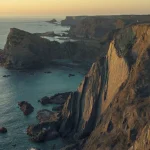
If you have one day to see what Portuguese coastline actually looks like away from tourist infrastructure, make it Arrábida. The Parque Natural da Arrábida stretches along a limestone mountain ridge that drops almost vertically into the Atlantic, producing cliffs of vivid white and ochre and water that genuinely turns turquoise on clear days. The beaches — Portinho da Arrábida, Galapinhos, and Galapos — rank among the most beautiful in Western Europe.
The water here is calm because the ridge blocks the Atlantic swell, and on a hot summer day the colour of the sea against the white limestone looks more like the Algarve than anywhere near Lisbon. But the access road is narrow, steep, and now subject to a vehicle access control system that limits cars entering the park between June and September. If you’re driving, you need to book a time slot in advance through the Setúbal municipality portal. Alternatively, take the ferry from Setúbal across the Sado estuary to Tróia, then drive south along the Arrábida coast from that direction — this avoids the vehicle quota system entirely.

Setúbal itself is a pleasant working city often skipped by visitors heading straight to the beaches. The Igreja de Jesus in the old centre contains the earliest example of Manueline architecture in Portugal, and the covered market near the waterfront is a good place for lunch before or after the coast.
- Getting there: No direct train to Arrábida beaches — take a Fertagus train to Setúbal (about 1 hour from Lisbon’s Pragal), then a taxi or organised tour to the park; or rent a car
- Organised day tours from Lisbon: €45–75 per person including transport and a guided boat trip along the cliffs
- Time needed: Full day essential — allow six to eight hours
Évora: Roman Ruins and Alentejo Silence
Évora is the farthest of the main day trips from Lisbon at around 130 kilometres, but the Alfa Pendular train covers the distance in about 90 minutes, making it a comfortable choice even for a short visit. The city has been continuously inhabited since Roman times and has the monuments to prove it: a 1st-century Roman temple sitting in the middle of the city, a 13th-century cathedral, a medieval university, and the genuinely unsettling Capela dos Ossos — a chapel whose walls and columns are decorated with the bones of approximately 5,000 monks.
Beyond the monuments, Évora introduces visitors to the Alentejo — Portugal’s great interior plateau — in a way that no amount of driving through it on a motorway can. The city is compact enough to explore on foot in a morning, and the surrounding cork oak plains stretch to every horizon. The light here in the afternoon is different from Lisbon: harder, flatter, and more golden, especially in late spring and autumn.

The Mercado Municipal near the main square runs in the mornings and is worth seeing even if you’re not buying anything. For lunch, the streets around Rua 5 de Outubro have several restaurants serving proper Alentejano food — the kind of place where the menu is handwritten and changes daily based on what was at the market that morning.
- Train from Oriente: Alfa Pendular, around 90 minutes, check CP’s 2026 schedule for departure times — typically two to three trains per direction daily
- Return train: Book in advance, as seats sell out on weekends and public holidays
- Entry to Capela dos Ossos: Around €5 in 2026
- Time needed: Four to six hours in the city comfortably covers the main sights
Óbidos: Medieval Walls You Can Actually Walk
Óbidos is the kind of place that photographs beautifully and delivers in person. A walled medieval village roughly 80 kilometres north of Lisbon, it sits on a low hill surrounded by farmland, its whitewashed houses trimmed in yellow and blue, and the entire perimeter of the walls open to walkers. You can walk the full circuit of the medieval ramparts — which takes about 30 minutes — and look out over the surrounding plain in every direction. There are no fences at the top. The drop is real and the view is open.
The main street, Rua Direita, runs through the village and is lined with shops selling the local ginjinha — the cherry liqueur served in a small chocolate cup that dissolves as you drink. It’s a tourist trap in the best possible sense: genuinely local, genuinely good, and completely specific to this place. The dark sweetness of the liqueur and the slight bitterness of the thin chocolate are impossible to separate from the experience of being here.

Óbidos works well combined with Caldas da Rainha, a larger market town 6 kilometres north, which has an excellent Saturday market and a pottery tradition dating back centuries. This combination makes for a more complete day than Óbidos alone, which is very small.
- Getting there: Take Rede Expressos bus from Sete Rios terminal in Lisbon — around 70–80 minutes, departures roughly every 90 minutes, cost around €9–11 one way in 2026
- No direct train to Óbidos town — the rail line serves Caldas da Rainha, which is 6 km away
- Time needed: Three to four hours in Óbidos itself; full day if combining with Caldas
Nazaré and Batalha: Waves and Gothic Stone
Nazaré is 120 kilometres north of Lisbon and famous globally since 2011 for producing the biggest surfable waves on Earth — a result of the Nazaré Canyon, an underwater trench that amplifies Atlantic swells to extraordinary heights. In winter, the waves at Praia do Norte regularly exceed 20 metres. Even if you visit in summer when the sea is calm, the canyon’s influence on the geography of the place is visible: the clifftop lighthouse at Sítio, reachable by funicular from the lower beach town, has a viewing platform that looks directly down on the break where the records are set.
Batalha, 18 kilometres inland from Nazaré, contains the Mosteiro da Batalha — a Gothic and Manueline monastery built to commemorate the 1385 Battle of Aljubarrota and recognised as a UNESCO World Heritage Site. The unfinished chapels at the rear of the monastery, open to the sky for 600 years, are one of the genuinely great pieces of medieval architecture in Europe. The stone tracery is extraordinarily detailed; standing inside and looking up at the open oculus against blue sky feels like standing inside a stone lace collar.

- Getting there: Rede Expressos bus from Sete Rios, around 2 hours to Nazaré, cost around €13–16 one way in 2026
- Combining both: Local buses connect Nazaré and Batalha — check schedules, as frequency is limited
- Batalha monastery entry: Around €7 in 2026
- Time needed: Full day; early start recommended
A Longer Push: The Douro Valley from Lisbon
The Douro Valley — Portugal’s great wine region — is most commonly visited as a day trip from Porto. But for travellers based in Lisbon who want to avoid backtracking, a direct approach is possible and rewarding, though it requires an early start and realistic expectations about what you can cover.
The fastest option in 2026 is the Alfa Pendular to Porto Campanhã (around 2 hours 45 minutes), then a regional train along the Linha do Douro to Pinhão, which takes another 2 hours. Pinhão sits at the heart of the Port wine country, surrounded by terraced vineyards stacked along the river valley. A few wine estates — quintas — offer tastings without advance booking, but most of the better ones require reservations.
This is realistically a 12-hour day from Lisbon, which is long. Many travellers who want the Douro experience use it as justification to overnight in the valley or spend a night in Porto each way. But if your trip doesn’t allow for that, the train journey along the Douro River itself — the last two hours from Peso da Régua to Pinhão — is one of the most beautiful rail journeys in Europe, and the glimpse of the valley it provides is worthwhile even on a tight schedule.
- Total travel time each way: Around 5 hours from Lisbon to Pinhão
- Train costs: Alfa Pendular Lisbon–Porto around €25–45 depending on advance booking; Douro regional train €8–12
- Best suited for: Travellers with a genuine interest in wine or the landscape who don’t mind a long day

Getting to Each Destination: 2026 Transport Reality
Transport options from Lisbon have improved and diversified in recent years, but some misconceptions persist. Here’s a clear picture of the options in 2026:
CP Trains
CP (Comboios de Portugal) runs reliable suburban services to Sintra (from Rossio), Cascais (from Cais do Sodré), and Setúbal (Fertagus line from Roma-Areeiro or Entrecampos, changing at Pragal). Long-distance Alfa Pendular trains serve Évora (from Oriente) and Porto/Douro. Book Alfa Pendular in advance at cp.pt — the system accepts international cards and the interface is now in English.
Buses
Rede Expressos covers Óbidos, Nazaré, Batalha, and many other towns not well served by rail. Departures from Sete Rios bus terminal, which connects directly to the Jardim Zoológico Metro station. Tickets can be bought online or at the terminal on the day for most routes, though popular weekend departures sell out.
Rental Cars
For Arrábida in particular, a rental car gives flexibility that public transport cannot match. Lisbon has several rental offices near Oriente and at the airport. The Via Verde electronic toll system is standard on most highways — your rental car will have a transponder and tolls are billed to your card. In 2026, the main A2 motorway to Setúbal has variable tolling based on traffic. Budget €8–15 for tolls on a typical day trip to the south.
Organised Tours
Dozens of operators run day tours from Lisbon to all the major destinations, typically departing from Praça do Comércio or Marquês de Pombal. These cost more than going independently but handle all logistics, include a guide, and are the only practical option for Arrábida beach access in summer without a private car. Prices in 2026 range from €35 for a basic Sintra group tour to €90+ for small-group Arrábida boat-and-hiking combinations.
Seasonal Timing: When Each Destination Rewards You Most
Choosing the right time of year changes the experience at each destination significantly — sometimes dramatically.
Sintra
The palace interiors are year-round. But the famous Pena Palace is most atmospheric between October and March, when morning fog rolls in from the Atlantic and the coloured towers emerge from the mist. Summer visits are crowded and hot on the exposed ridgeline. Spring (April–May) offers wildflowers in the forest and manageable visitor numbers.
Arrábida
June through September for swimming — the water temperature peaks at around 22°C in August. Outside this window, the park is less crowded and the hiking is excellent, but the vehicle access restrictions also ease considerably, making logistics simpler.
Nazaré for Waves
November through February for big wave season. The WSL surfing events at Nazaré typically fall between October and March. Summer is beach-holiday season but the legendary waves don’t exist then.
Évora
Spring and autumn are ideal — the Alentejo summer heat regularly exceeds 38°C and makes outdoor exploration uncomfortable by midday. October is particularly good, when the light is golden and the cork oak forests outside the city turn.
Óbidos and Batalha
Both work well year-round. Óbidos hosts the Mercado Medieval every July, when the village transforms into a medieval market with costumed traders and fire shows — the most atmospheric time to visit, though also the busiest.
What Each Day Trip Will Cost You: 2026 Budget Breakdown
Costs vary significantly depending on how you get there and what you do. These are realistic all-in figures for a single person for a full day trip from Lisbon, including transport, entry fees, lunch, and drinks.
Sintra
- Budget: €35–45 (train + 1–2 palace entries + sandwich lunch)
- Mid-range: €60–80 (train + multiple palace entries + sit-down lunch)
- Comfortable: €100+ (private transfer + all palaces + wine at Lawrence’s Hotel)
Cascais
- Budget: €20–30 (train + beach + takeaway lunch)
- Mid-range: €50–70 (train + bike hire + restaurant lunch)
- Comfortable: €100–130 (private transfer + wine + seafood restaurant)
Arrábida
- Budget: €50–65 (bus to Setúbal + taxi to beach + packed lunch)
- Mid-range: €70–90 (organised tour with boat trip included)
- Comfortable: €120+ (private car hire + seafood lunch in Portinho)
Évora
- Budget: €35–50 (train + chapel entry + market lunch)
- Mid-range: €70–90 (train + multiple monuments + restaurant lunch with wine)
- Comfortable: €120+ (Alfa Pendular + guided tour + long Alentejano lunch)
Nazaré + Batalha
- Budget: €40–55 (bus + monastery entry + café lunch)
- Mid-range: €70–85 (bus + seafood lunch in Nazaré + monastery)
- Comfortable: €100–130 (private car + long lunch + surf spectating guide in season)
Frequently Asked Questions
What is the best day trip from Lisbon for first-time visitors?
Sintra is the most iconic and easiest to reach by train in under 45 minutes from Rossio station. It works well for first-timers who want maximum visual impact in a single day. Book timed entry for Palácio da Pena in advance, especially for weekend visits between April and October.
Can you do multiple day trips in one day from Lisbon?
Cascais and Sintra are sometimes combined, but both deserve more time than a rushed combination allows. Nazaré and Batalha pair well together geographically. Beyond those two pairings, trying to combine unrelated destinations in a single day will feel rushed and is generally not worth it.
Do I need a car for day trips from Lisbon?
Not for most of them. Sintra, Cascais, and Évora are easily reached by train. Buses cover Óbidos, Nazaré, and Batalha. Arrábida is the one destination where a car makes a meaningful difference, especially outside peak summer when access restrictions are lighter.
How far in advance should I book day trip tickets and entry passes?
For Sintra’s Pena and Mouros palaces on weekends from April to October, book at least 48 hours ahead through the Parques de Sintra website. For Alfa Pendular trains to Évora or Porto, book a week or more in advance on busy weekends. Organised tours to Arrábida sell out 3–5 days ahead in July and August.
Are day trips from Lisbon suitable for children?
Sintra’s forest walks and Pena Palace work very well for children. Cascais beach days are ideal for families. Arrábida’s calm, clear water is excellent for children who swim. Évora’s Capela dos Ossos is notable but some younger children find it disturbing — worth knowing before you walk in.
Explore more
Where to Stay in Lisbon: Choosing the Perfect Neighbourhood for Your Trip
📷 Featured image by Francois Le Nguyen on Unsplash.